India's Heritage Diplomacy: From Angkor Wat to Prambanan, How New Delhi Is Restoring Shared Civilisations Across Asia
India has steadily expanded its cultural diplomacy by helping restore ancient temples and heritage sites across Asia. With the launch of a new conservation project at Indonesia's Prambanan Temple, New Delhi's heritage partnerships now span Cambodia, Myanmar, Nepal, Sri Lanka, Vietnam, Bangladesh, Laos and Bahrain—strengthening diplomatic ties through shared civilisational history. By Mahima Katal India's cultural diplomacy received another significant boost on Wednesday as Prime Minister...
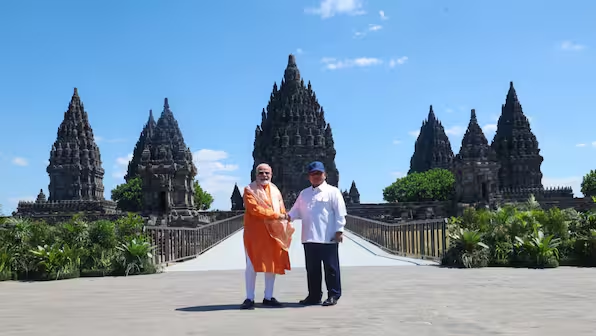
India has steadily expanded its cultural diplomacy by helping restore ancient temples and heritage sites across Asia. With the launch of a new conservation project at Indonesia's Prambanan Temple, New Delhi's heritage partnerships now span Cambodia, Myanmar, Nepal, Sri Lanka, Vietnam, Bangladesh, Laos and Bahrain—strengthening diplomatic ties through shared civilisational history. By Mahima Katal India's cultural diplomacy received another significant boost on Wednesday as Prime Minister Narendra Modi and Indonesian President Prabowo Subianto inaugurated a conservation project at the UNESCO World Heritage-listed Prambanan Temple complex in Yogyakarta.
The initiative marks the latest chapter in India's growing effort to preserve shared civilisational heritage across Asia, with the Archaeological Survey of India (ASI) leading the restoration work under a bilateral agreement signed a day earlier.
The project reflects New Delhi's broader strategy of using heritage conservation as a pillar of foreign policy, combining archaeological expertise with diplomatic engagement.
Heritage Conservation as Soft Power
Over the past decade, India has increasingly positioned itself as a partner in restoring ancient monuments that reflect centuries of cultural, religious and historical connections across the region.
Since 2014, the Indian government has extended financial assistance, technical expertise and conservation support to multiple countries, particularly those with historical links to Hindu and Buddhist civilisations.
These initiatives are viewed not merely as restoration projects but as instruments of cultural diplomacy, reinforcing India's role as a custodian of shared Asian heritage.
Cambodia: Preserving the Legacy of Angkor
Among India's most prominent conservation efforts is its work in Cambodia's Angkor Archaeological Park.
Since 2022, the ASI has undertaken restoration and conservation of important sections of the UNESCO-listed heritage complex, including Angkor Wat, Ta Prohm and Preah Vihear.
The projects seek to preserve one of the world's greatest centres of Hindu architecture while strengthening India-Cambodia cultural cooperation.
Indonesia: A New Chapter at Prambanan
India's latest heritage partnership focuses on the Prambanan Temple complex, one of Southeast Asia's largest Hindu temple sites.
Dedicated primarily to the Trimurti—Brahma, Vishnu and Shiva—the ninth-century monument stands as one of Indonesia's most significant symbols of its ancient Hindu past.
The ASI will provide conservation expertise as part of the joint restoration initiative, adding Indonesia to India's expanding list of heritage partners.
Sri Lanka and Vietnam
India has also supported the restoration of sacred sites in Sri Lanka and Vietnam.
In Sri Lanka, New Delhi provided grant assistance for the restoration of the historic Thiruketheeswaram Temple, one of the island's five ancient Pancha Ishwarams dedicated to Lord Shiva.
In Vietnam, India signed an agreement to restore the UNESCO-listed My Son Sanctuary, the religious and political centre of the ancient Champa Kingdom and one of Southeast Asia's most important Shaivite temple complexes.
Myanmar and Nepal
Following the devastating earthquake in Myanmar, India partnered with the country's authorities to restore monuments in the UNESCO-listed Bagan Archaeological Zone.
The ASI restored 12 historic pagodas and completed conservation work at the iconic Ananda Temple.
In neighbouring Nepal, India funded the restoration of 28 heritage sites under its post-earthquake reconstruction programme, including temples and religious structures that hold immense historical and cultural significance.
Bangladesh, Laos and Bahrain
India's heritage partnerships extend beyond Southeast Asia.
In Bangladesh, New Delhi financed the reconstruction of the Joy Kali Mata Temple and supported restoration of the Ramna Kali Temple, Anandomoyee Kali Mata Mandir and the Ramakrishna Temple, helping revive important centres of worship and cultural identity.
In Laos, India assisted in conserving key structures of the UNESCO-listed Vat Phou Temple, an ancient Shiva temple dating back nearly a millennium.
Meanwhile, in Bahrain, India supported the redevelopment of the historic Shreenathji Temple in Manama, preserving one of the Gulf region's oldest Hindu places of worship.
A Civilisational Approach to Diplomacy
Speaking at Prambanan, Prime Minister Modi said that cultural heritage transcends borders and connects societies across generations.
India's restoration initiatives increasingly reflect this philosophy, positioning heritage conservation as a bridge between nations rather than merely an archaeological exercise.
As geopolitical competition intensifies across the Indo-Pacific, New Delhi's investment in restoring temples, monuments and historic sites offers a distinct form of engagement—one rooted in shared history, cultural continuity and long-term people-to-people ties.
Through these projects, India is reinforcing its image as a partner committed not only to economic and strategic cooperation but also to preserving the civilisational legacy that links much of Asia.