SHANTI, UNCLOS and the Unnamed Subtext: Decoding Jaishankar's UNSC Launch
Jaishankar's UNSC launch speech uses legal language to make unstated arguments. "Rule-based maritime order" responds to the Hormuz crisis and seafarer attacks without naming Iran or Israel. "Evidence-based listing" of terror groups targets China's history of blocking Masood Azhar-style UNSC listings, without naming China. Peacekeeping and AI planks convert India's UN contributions into a legitimacy case ahead of the 2027 election against Tajikistan. The real function: diplomatic language...
Jaishankar's UNSC launch speech uses legal language to make unstated arguments. "Rule-based maritime order" responds to the Hormuz crisis and seafarer attacks without naming Iran or Israel. "Evidence-based listing" of terror groups targets China's history of blocking Masood Azhar-style UNSC listings, without naming China. Peacekeeping and AI planks convert India's UN contributions into a legitimacy case ahead of the 2027 election against Tajikistan. The real function: diplomatic language doing political work while avoiding direct accusation.
By Mahima Katal
New Delhi, July 14: At UN headquarters, External Affairs Minister S. Jaishankar formally opened India's campaign for a non-permanent Security Council seat for 2028-29 — India's ninth attempt at a seat it has held eight times since 1950. The speech was framed around an acronym, SHANTI (Securing Holistic Advancement through Norms, Trust and Integrity), and a list of six priorities: Global South representation, reformed multilateralism, future-ready peacekeeping, AI governance, maritime security, and counter-terror financing. Read as a diplomatic wish list, it's unremarkable — every UNSC aspirant runs some version of this menu. Read against the news cycle it landed in, it's considerably more specific than it sounds.
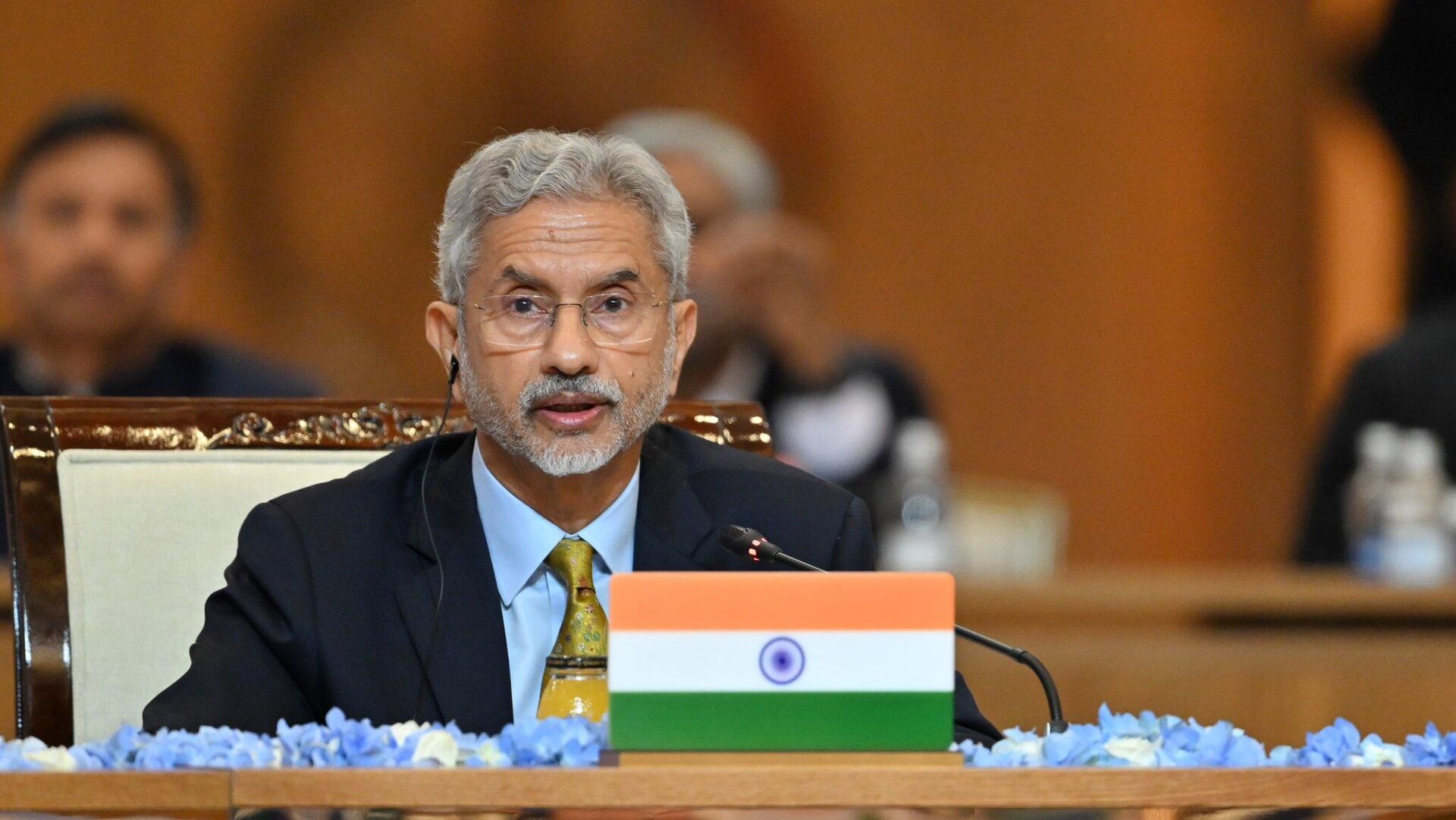
External Affairs Minister S. Jaishankar. (File Image)
The maritime language isn't generic — it's dated to this month
Jaishankar didn't invoke "securing the maritime commons" in the abstract. He tied it explicitly to seafarer safety, and that framing arrives days after Indian seafarers were killed and others rescued in strikes on commercial vessels amid the US-Israel-Iran confrontation and the resulting disruption around the Strait of Hormuz — a chokepoint through which roughly a fifth of the world's peacetime energy supply moves. The speech never names Iran, Israel, or the Houthis. It doesn't need to. "Adherence to relevant international law, specifically UNCLOS" and "safe and unimpeded flow of maritime commerce" are UNCLOS-coded phrases that function as a legal register for describing a coercion problem without assigning blame to a specific state — useful for a UNSC candidate who cannot afford to prejudge a live P5-adjacent conflict before even winning the seat.
This is the throughline from the Vijay-government cow slaughter piece, structurally: a legal framework is being used to make an argument that everyone understands is really about something else. There, Article 48 stood in for an unstated religious-political contest. Here, "rule-based maritime order" stands in for an unstated geopolitical one — India positioning itself as a norms-following naval and diplomatic power against the fact-pattern of chokepoint coercion, without ever litigating who's doing the coercing.
Why India needs the "law" framing to be doing this much work
India's own maritime security footprint — anti-piracy operations, counter-narcotics patrols, protecting sea lanes across the northern and southern Arabian Sea, the Gulf of Aden, the Malacca Straits, even the Gulf of Guinea — is a demonstration of naval capability, not just legal commitment. But Jaishankar's speech consistently subordinates the capability to the law: India isn't asking for a seat because it can project power at sea, it's asking for one because it will hold other states to the same UNCLOS standard it holds itself to. That's a deliberate rhetorical choice for a Security Council campaign, where the pitch to smaller and non-aligned states is "rule-following power," not "power," full stop.
The terror-financing plank is doing similarly precise work
Jaishankar's language here was sharper than his maritime framing — he explicitly said counter-terrorism efforts have focused too long on symptoms rather than resource bases, and called for objective, evidence-based listing of terrorist groups. That last phrase is not neutral. "Evidence-based listing" is diplomatic shorthand aimed squarely at the UNSC's 1267 Sanctions Committee, where India has repeatedly and publicly accused China of using procedural holds to block the listing of Pakistan-based terrorists — Masood Azhar's listing took nearly a decade of exactly this kind of blocking before it went through in 2019. Jaishankar doesn't name China here either. He doesn't have to; the diplomatic audience in the room knows precisely which listing disputes "evidence-based" is responding to.
What the SHANTI framing is actually selling
The peacekeeping and AI planks read as India's attempt to convert existing assets into UNSC currency: 4,300 personnel deployed across ten of eleven active UN peacekeeping missions is a genuine, quantifiable claim most Council aspirants can't match, and the "human-centric AI" framing lets India position itself as a Global South-aligned counterweight to both Western AI-safety framing and Chinese AI-diplomacy framing, without committing to specifics on either.
The subtext, named plainly
Strip the acronym and the six-point list away, and the speech is doing three things simultaneously: signaling concern about Hormuz and Gulf shipping risk without naming a party to blame; pressing an old grievance about terror-group listings without naming the state accused of obstruction; and converting quantifiable peacekeeping and naval contributions into a case for legitimacy that doesn't require India to take a side in any live conflict before the June 2027 election, when India and Tajikistan will contest the Asia-Pacific seat. That's not evasiveness — it's the standard grammar of multilateral campaigning.
But it's worth naming precisely because the "rule-based" and "evidence-based" language throughout is engineered to be read very differently by different capitals in that room, and that's not incidental to the speech. It's the point of it.