The MANAV Vision: India’s Leap Into The Global AI Vanguard
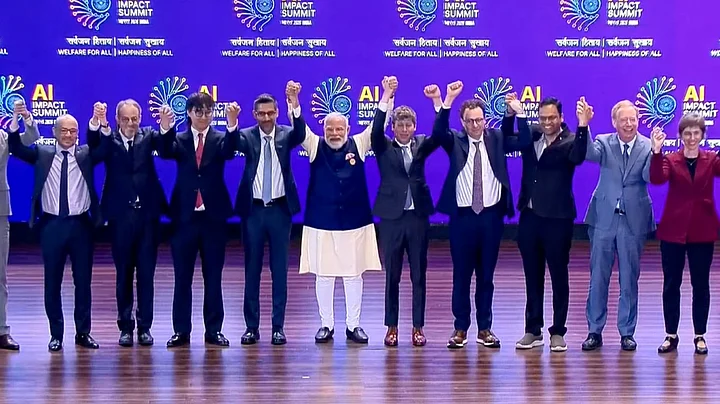
The Slate Bureau New Delhi: In the sprawling halls of Bharat Mandapam in New Delhi, the air is thick with a different kind of electricity. It is February 2026, and the India AI Impact Summit is reaching its crescendo. For five days, the world’s most influential tech titans—from OpenAI’s Sam Altman to the heads of Nvidia and Google—have gathered in the Indian capital. But this isn't just another tech conference; it is the moment India officially claimed its seat as the moderator of the...
The Slate Bureau
New Delhi: In the sprawling halls of Bharat Mandapam in New Delhi, the air is thick with a different kind of electricity. It is February 2026, and the India AI Impact Summit is reaching its crescendo. For five days, the world’s most influential tech titans—from OpenAI’s Sam Altman to the heads of Nvidia and Google—have gathered in the Indian capital. But this isn't just another tech conference; it is the moment India officially claimed its seat as the moderator of the "Silicon Century."
Human-Centric Innovation
At the heart of the summit is Prime Minister Narendra Modi’s unveiling of the MANAV Vision (Machine-Augmented Network for Human Values). The initiative is a bold attempt to pivot the global AI conversation away from raw computing power and toward ethical, human-centric application.
"AI must not be a tool that deepens global divides," the Prime Minister told the Leaders' Plenary Session. "It must be a bridge." The MANAV framework proposes a "glass box" approach to algorithms—demanding transparency in how AI models make decisions, especially in critical sectors like healthcare and law.
The $200 Billion Blitz
The summit served as a stage for eye-popping economic commitments. Domestic giants like Reliance and the Tata Group announced a combined ₹10 lakh crore ($120 billion) investment plan over the next seven years to build localized AI infrastructure. This includes "AIKosh," a national dataset platform that has already democratized over 7,500 datasets for Indian startups, allowing them to train models that understand the nuances of India's 22 official languages.
Perhaps most significantly, on the summit's final day, India formally joined Pax Silica, the U.S.-led effort on AI and supply chain security. This strategic alignment signals a move to decouple critical tech manufacturing from traditional regional hubs, positioning India as the primary alternative for high-end semiconductor and AI-server production.
From Agriculture to High Finance
The practical applications of this "AI revolution" are already visible outside the conference walls. In rural Karnataka, farmers are using lightweight AI models—which UNESCO recently praised for using 90% less energy—to predict pest outbreaks with 98% accuracy. In the financial sector, the Unified Payments Interface (UPI) has integrated AI-driven fraud detection that operates at a scale the world has never seen, processing millions of transactions per second with near-zero latency.
As the summit concludes, the "New Delhi Declaration on AI Governance" stands as a testament to India’s unique role. By balancing the interests of the Global South with the technological might of the West, India isn't just consuming the future; it is coding it.