Anthropic's Independence Is Conditional, and Its IPO Filing Shows Why
Google, Amazon, Anthropic relation: Amazon and Google supply Anthropic’s computing power, sell Claude through their cloud marketplaces, and compete for the same AI customers.
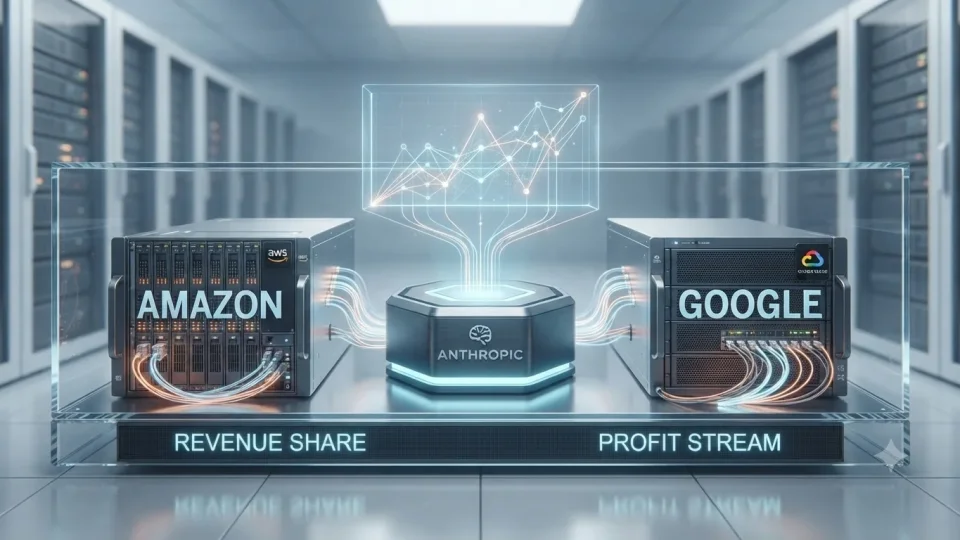
Anthropic depends on Amazon and Google to reach customers, secure computing power, and collect payments, even as both companies invest in it and compete against it in artificial intelligence. Its IPO disclosures reveal an unusually tangled business model at the heart of the AI boom. Anthropic, the maker of the Claude AI models, has built one of the fastest-growing businesses in artificial intelligence. But its filings show that its growth rests on a few tech companies that are simultaneously its investors, suppliers, sales channels, customers, and rivals.
In its Form S-1/A-2 filing with the US Securities and Exchange Commission, Anthropic said that Amazon, Google and Microsoft “simultaneously serve as our investors, customers, distribution partners, and competitors”, creating potential conflicts of interest.
A Circular Relationship
Amazon and Google invest in Anthropic, provide the cloud infrastructure it needs, sell Claude through their marketplaces and collect payments from customers on its behalf. At the same time, both companies develop competing AI products and compete for the same enterprise customers. Anthropic says the arrangement gives it access to vast sales networks and customers already using Amazon Web Services, Google Cloud and Microsoft Azure. In its filing, Reuters says, it argued that distributing Claude through these platforms could accelerate market penetration “at a scale we believe would be difficult for any single organization to directly replicate”.
But the same disclosure acknowledges the risk: reliance on a limited number of partners and suppliers “creates complex dynamics that could give rise to conflicts of interest and adversely affect our access to compute”.
Also Read: Nvidia Halts AI Chip Shipments to China as US Export Controls Tighten
Cost and Revenue of the Big Tech
In 2025, Anthropic generated about $2.16 billion, or 47% of annual revenue, through Amazon and Google’s cloud marketplaces. The report further states that it paid roughly $351 million back to the platforms in distribution fees, about 16 cents for every dollar of those marketplace sales. The dependence has reportedly increased. Sales through Amazon, Google and Microsoft cloud marketplaces accounted for about 44% of Anthropic’s revenue in the first nine months of 2026, up from 11% in 2023, according to the prospectus.
Role |
Amazon |
|
|
Investor |
Holds about 14.6% of Anthropic after the IPO |
Holds about 13.4% after the IPO |
|
Compute supplier |
Provides cloud capacity, including Trainium-based infrastructure |
Supplies Google Cloud capacity and TPUs used by Anthropic. |
|
Distribution channel |
Sells Claude through AWS Marketplace |
Sells Claude through Google Cloud Marketplace. |
|
Competitor |
Develops AI products and competes for enterprise AI demand |
Develops Gemini and competes directly in frontier AI. |
Suppliers With a Stake
The relationship extends beyond sales. Amazon and Google are also critical suppliers of the computing capacity Anthropic needs to train and run its models. Anthropic has committed enormous sums to secure that capacity, with Reuters reporting that its computing commitments with partners including Amazon and Google approached $900 billion.
At the end of 2025, Anthropic had $54.6 billion in non-cancellable hosting and computing commitments. By early 2026, its total long-term commitments exceeded $417 billion, covering 3.5 gigawatts of dedicated computing capacity. That means Anthropic is not simply buying services from Amazon and Google. It is making multi-year financial commitments to companies that also hold equity in it and compete with it for AI customers.
Conflict of Interest
The central question is whether Amazon or Google could use its position to favour its own AI products. Anthropic’s filing says the cloud providers gain visibility into its pricing and commercial terms, which could influence decisions on compute allocation and how aggressively they sell Claude. The companies also use Anthropic’s products, making them customers as well as distributors. That gives them commercial insight into the business while they compete with it elsewhere in the AI market. Anthropic has not publicly alleged that either company has acted against its interests.
Why the Model Works for Now
For Amazon and Google, backing Anthropic can make commercial sense even if it competes with their own AI products. Investment gives them exposure to Anthropic’s upside, while Anthropic’s growth increases demand for their cloud infrastructure, chips, data centres and networking equipment. It is thus a loop wherein a large share of the money Anthropic spends on compute and channel fees returns to companies that also fund, own or resell it.
The arrangement is most stable while demand is strong. If AI growth slows, however, the same suppliers would be exposed both through their equity stakes and through the contracted capacity Anthropic has promised to buy.
A Risky Dependence
Anthropic’s customer base adds another vulnerability. Two unnamed customers each generated 12% of its 2025 revenue, according to the IPO filing, and many of its largest customers are not bound by long-term contracts, reports Reuters. The company also reportedly warned that disputes or delays in the payment pipeline could affect cash flow, even where it contracts directly with customers. At the end of 2025, third-party cloud platforms collected 60% of the $909 million in customer bills outstanding.
For a company seeking to become a leading independent AI developer, the disclosures present an uncomfortable paradox: Anthropic needs Amazon and Google to grow, but the more it grows through them, the more power it may concede to companies with competing interests.
Anthropic’s model is not necessarily unsustainable. Its scale, enterprise customer base, and access to multiple suppliers give it some bargaining power, and its investors have an incentive to keep a major AI customer alive and growing.
But the filing makes clear that Anthropic’s independence is conditional. Its access to customers, computing capacity, and cash collection increasingly runs through companies that are also its competitors, a structure that could shape pricing, distribution, and access to compute as the AI market matures.