GST Gets An Automated Exit Route, but Compliance Remains the Price
GST Registration Cancellation: The government has introduced an automated mechanism for GST registration cancellation from December 1, 2026. While eligible taxpayers can expect faster processing through the GST portal, businesses must first file pending returns and clear outstanding tax dues, interest, fees and penalties.
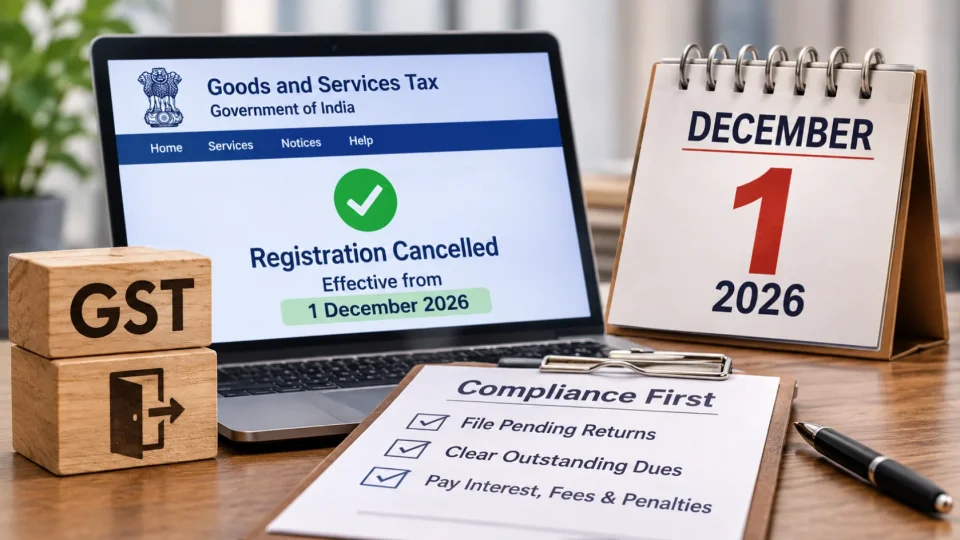
GST Registration Cancellation: India's Goods and Services Tax (GST) administration is moving towards a simpler process for businesses seeking to surrender their registration. From December 1, 2026, eligible taxpayers will no longer have to wait for an officer to process their cancellation applications. Instead, the GST common portal will electronically cancel registrations once the prescribed return-filing and payment conditions are met.
The change, notified by the Ministry of Finance through Notification No. 08/2026–Central Tax on November 25, is part of the government's broader effort to reduce procedural delays and make GST administration more technology-driven. However, the automated route comes with an important condition: businesses must have filed the required returns and cleared their outstanding tax liabilities, including interest, fees and penalties. The amendment therefore makes the process of exiting the GST system easier, but does not relax the compliance obligations that come with it.
Also Read: Congress-Meta Face-Off Puts Political Content Moderation Under Scrutiny
What Changes from December 1?
The notification introduces the Central Goods and Services Tax (Second Amendment) Rules, 2026, and replaces sub-rules (5) and (6) of Rule 20 of the CGST Rules, 2017. Under the revised provision, when a taxpayer applies for cancellation and has furnished the returns prescribed under Rule 20 within the specified time, while also paying all outstanding tax, interest, fees, penalties and other amounts due, the GST common portal will electronically cancel the registration.
The cancellation will take effect from the date requested by the taxpayer. The applicant will receive electronic communication of the cancellation in Form GST REG-38. However, applications will not automatically pass through the system in every case. If the required returns or statements, including Form GST CMP-08 wherever applicable, have not been furnished, or if any outstanding liability remains unpaid, the application will be forwarded to the proper officer for examination. This distinction is important. The amendment does not eliminate the role of tax officials in the cancellation process. Instead, it creates an automated route for taxpayers who have met the prescribed conditions, while retaining official scrutiny for cases involving pending compliance requirements.
Why Does GST Registration Cancellation Matter?
GST registration is not simply an administrative formality. It determines whether a business is recognised as a registered taxpayer under the indirect tax system and carries continuing obligations relating to tax payments, invoicing and return filing. Under Section 29 of the Central Goods and Services Tax Act, 2017, a registered person can seek cancellation in circumstances such as the closure or discontinuation of a business, transfer of the business, a change in its constitution resulting in a change of PAN, or when the person is no longer liable to remain registered.
For instance, a small business that shuts down operations, an entrepreneur who discontinues a venture or a proprietor who restructures a business may need to surrender the GST registration. The cancellation process allows the taxpayer to formally exit the system rather than continue holding an active registration.
Under Rule 20, taxpayers apply for cancellation electronically through Form GST REG-16. The application requires details of inputs and capital goods held in stock on the proposed cancellation date, the tax liability arising from them and payments made against those liabilities. The requirement to furnish returns and settle outstanding liabilities is also important because cancellation does not automatically extinguish a taxpayer's previous obligations. Businesses remain accountable for their tax liabilities arising before the effective date of cancellation.
A Shift Towards System-Based Tax Administration
The latest amendment reflects a wider shift in how the GST administration is attempting to handle routine taxpayer services. Instead of requiring manual intervention at every stage, the government is increasingly relying on portal-based validation and automated processing for applications that meet prescribed conditions.
This has two important implications for businesses. First, applications that satisfy the conditions can be processed without waiting for an individual tax officer to examine and approve them. Second, the system can direct applications involving pending returns or unpaid liabilities for examination by the proper officer. The distinction matters because automation is not the same as unconditional approval. The new provision establishes a rule-based mechanism in which the applicant's compliance record determines whether the application qualifies for electronic cancellation.
It could also make the process more predictable for businesses that have completed their tax obligations. However, the actual reduction in processing time will depend on how efficiently the GST portal implements the new mechanism and how it handles discrepancies in taxpayer records.