How an 18-Year-Old Made 54.8 Crore UP Voter Records Searchable
Eighteen-year-old ethical hacker Sarthak Sidhant has digitised 6.8 lakh PDFs containing Uttar Pradesh's electoral rolls, converting 54.8 crore voter records into searchable data.
Sarthak Sidhant UP Voter List Digitisation: The 18-year-old ethical hacker whose work forced the Indian government to take action into procurement and an official acknowledgement of security vulnerabilities in the Central Board of Secondary Education's (CBSE) On-Screen Marking (OSM) portal, has made another complicated process accessible to the public. Sarthak Sidhant, a Ranchi resident, has made lakhs of electoral roll documents searchable, allowing voters, researchers and journalists easy to examine information that would otherwise take considerable time and effort to access.
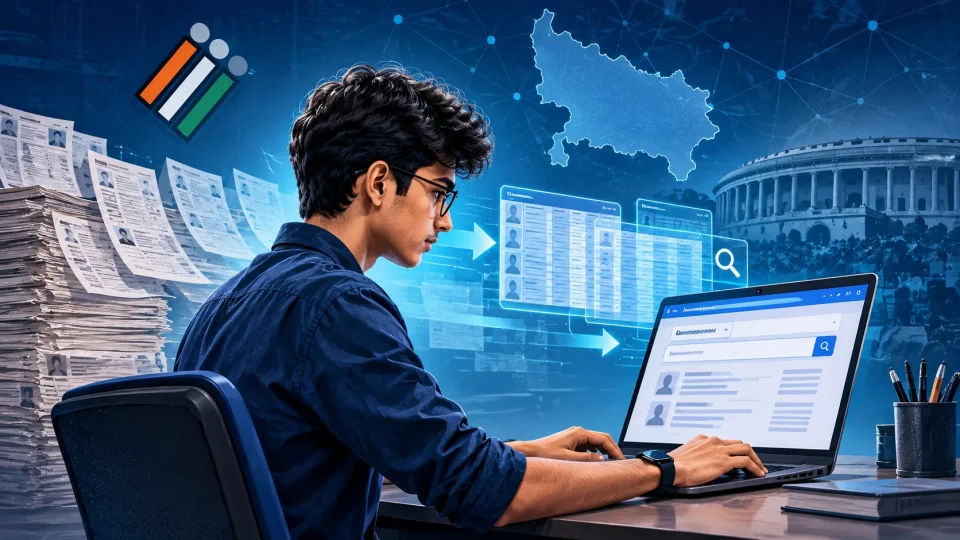
On November 24, Sidhant announced on X, formerly Twitter, that he and his team had digitised 6.8 lakh PDF files containing Uttar Pradesh's electoral rolls. The team converted scanned, image-based documents into a structured dataset covering 54.8 crore voter records across all 403 Assembly constituencies in the state. The exercise addresses a practical problem with how electoral information is published. Although the ECI makes voter lists available online, much of the material comes in the form of scanned PDFs. A person looking for a name may have to identify the correct constituency and polling booth, download the relevant document and manually go through its pages.
hello chat, we OCR'd every voter rolls PDF that the ECI put out of Uttar Pradesh. the 2024 Lok Sabha roll, both SIR rolls and the 2027 draft. 6.8 lakh PDFs, mostly scans. Now 54.8 crore rows, one table for each of the 403 constituencies. Free to download, Link below. https://t.co/eyW6CwNi3R
— Sarthak Sidhant (@sidhant_sarthak) November 24, 2026
This becomes particularly difficult during an exercise such as the SIR, when voters may need to check their entries, identify changes or establish whether their names appear in the revised rolls. Sidhant's intervention attempts to remove that difficulty. By converting the documents into machine-readable data, he has made it easier to search, compare and examine electoral records on a much larger scale.
The initiative has also drawn appreciation from opposition politicians, journalists and civil society members, who see access to electoral information as an important part of democratic accountability.
From Questioning CBSE's Evaluation System to Scrutinising Public Records
For Sidhant, the voter roll project is part of a wider effort to make public institutions and their records easier to scrutinise. His earlier engagement with the CBSE began with a personal grievance. After the declaration of his Class 12 results in May, he noticed discrepancies in his marks. He sought scanned copies of his evaluated answer sheets and began examining the board's newly introduced On-Screen Marking system. What began as an attempt to understand his own results soon developed into a wider investigation of the system.
By late May and early June, Sidhant was examining successive versions of CBSE's tender documents. He flagged changes in eligibility criteria, technical requirements and other conditions governing the selection of the company responsible for the digital evaluation system. On June 2, he presented his findings in a seven-page document before the Parliamentary Standing Committee on Education, chaired by Congress MP Digvijaya Singh.
His work subsequently moved beyond the education sector. On June 26, he shared a public database containing approximately 1.66 crore government procurement records scraped from the Centre's Central Public Procurement Portal. The database offered another example of how technology could help citizens examine information already held in government systems but not necessarily easy to access or analyse.
On November 20, Sidhant's inclusion in TIME100 Next India 2026 brought wider recognition to his work. Four days later, he announced the voter roll digitisation project, extending his transparency efforts to an institution directly connected with the electoral process.
6.8 Lakh PDFs and 54.8 Crore Records: What did the Team do?
The scale of the latest exercise is significant. Sidhant and his team processed 6.8 lakh PDF files containing electoral roll information from Uttar Pradesh. According to his post on X, the team used Optical Character Recognition (OCR) to extract information from the documents and convert it into machine-readable data.
OCR technology allows computers to recognise printed text within scanned images. Instead of treating a PDF page as a photograph, the technology identifies the words and numbers on it, making them searchable and easier to process. This is particularly useful when dealing with electoral rolls that run into thousands of pages and lakhs of individual documents.
Sidhant said the team processed the electoral roll PDFs released by the ECI for Uttar Pradesh, converting them into 54.8 crore rows of data. The information was organised into tables covering the state's 403 Assembly constituencies. The exercise covered four sets of electoral rolls: the list used for the 2024 Lok Sabha elections, the draft and final rolls prepared during the SIR, and the 2027 draft electoral roll.
The inclusion of multiple versions is important because it allows users to examine changes across different revision cycles rather than looking at a single electoral roll in isolation. For instance, someone trying to understand whether an entry has changed between two versions can use the structured dataset to make comparisons more efficiently. Researchers and journalists can also examine larger patterns in the data without having to manually inspect thousands of PDFs.
The team has also taken steps to protect personal information in the publicly downloadable files. Sensitive identifiers, including names, relatives' names, EPIC numbers and house numbers, have been replaced with keyed-hash tokens. The underlying entries can still be checked against the original ECI PDFs. This approach attempts to balance easier public scrutiny with safeguards for personal information.
Why Making Electoral Rolls Searchable Matters
Electoral rolls are not simply administrative documents. They determine who can exercise the right to vote. During an SIR, when electoral records undergo revision, voters may need to check whether their names appear in the relevant lists, whether their details are correct and whether any changes have taken place.
For someone with reliable internet access and familiarity with digital documents, searching through a PDF may be manageable. For others, particularly those unfamiliar with navigating large files, the process can become frustrating and time-consuming. The difficulty becomes greater when a voter does not know which document contains the relevant entry or has to compare records from different years.
This is where machine-readable electoral data can make a difference. It reduces the time required to locate information and allows people to examine records more systematically. The initiative also comes amid wider demands for machine-readable electoral rolls from the Opposition, led by Leader of the Opposition in the Lok Sabha, Rahul Gandhi.
The Uttar Pradesh Chief Electoral Officer's office had introduced searchable and downloadable PDFs for the 2027 draft electoral roll on November 17. However, Sidhant's exercise goes further in its scope by bringing together four sets of electoral rolls and processing hundreds of thousands of documents into a consolidated dataset. The distinction matters. Publishing a document online is only the first step. Making its contents searchable, comparable and usable determines how easily citizens can actually work with the information.
'Doing the government's work': Sidhant's initiative draws praise
Sidhant's initiative has attracted appreciation from politicians, journalists and others who have called for greater transparency in the electoral process. Congress MP from Assam, Gaurav Gogoi, supported the effort in a post on X on Tuesday. "I support the work done by Sarthak Sidhant. It is long and painstaking but essential. Democracy is served when citizens are vigilant and the institutions meant to serve the public are under scrutiny," Gogoi wrote.
I support the work done by @sidhant_sarthak . It is long and painstaking but essential. Democracy is served when citizens are vigilant and the institutions meant to serve the public are under scrutiny.
— Gaurav Gogoi (@GauravGogoiAsm) November 24, 2026
Senior journalist Pankaj Pachauri also praised the project, arguing that Sidhant and his team had taken up work that the Election Commission had not undertaken. "This is true public service. Doing Government's work because the ECI will not dare to do it," Pachauri wrote on X. The comments reflect a larger debate about the accessibility of electoral information and the responsibility of public institutions to make their records usable.
The ECI's publication of electoral rolls provides citizens with access to official records. But the format in which these records appear can determine how effectively people can examine them. Sidhant's project does not replace the ECI's official electoral rolls. Rather, it offers another way to organise and examine the information contained in them. Voters must still refer to the official records for verification.