Modi's Wage Question: Why Are Corporate Profits Growing Faster Than Workers' Pay?
India's corporate profits have reached a 15-year high, but employment growth has failed to keep pace. The Economic Survey 2024-25 reported that the profit-to-GDP ratio of Nifty 500 companies rose to 4.8% in FY24, while corporate profits grew by 22.3% and employment increased by just 1.5%. The widening gap raises questions about whether rising corporate earnings are translating into jobs and broader economic gains.

Modi's Wage Question on Corporate Profits and Workers' Pay: Prime Minsiter Narendra Modi's remark on corperate firms' modest hiring despite years of government support has opened a crucial conversation on a widening gap between corporate earnings and workers' compensation. It raised questions on corperate about how businesses are distributing the gains from economic growth.
Addressing industry leaders at the Federation of Indian Chambers of Commerce and Industry (FICCI) annual meeting on November 19, PM Modi expressed dissatisfaction with the limited improvement in wages and employment despite the support extended to businesses. He urged industry to do more to generate jobs and improve employee compensation.
The question is particularly relevant against the backdrop of rising corporate profits. According to figures cited in the original report, corporate profits increased from Rs 6.14 trillion in FY21 to Rs 11.56 trillion in FY25, while employment rose from 16.09 million to 21 million. Wage bills, meanwhile, grew at a slower pace than profits. The disparity raises a larger question: if companies are earning substantially more, why are workers not sharing proportionately in those gains?
Also Read: Why BJP Needs The SAD For A Jubilant Win In Punjab
Profits Are Rising Faster Than Employee Compensation
The gap between corporate profitability and employee compensation is not limited to the figures cited in the recent debate. The Economic Survey 2024-25 reported that the profit-to-GDP ratio of Nifty 500 companies reached 4.8% in FY24, its highest level since FY08. Corporate profits grew 22.3% that year, while employment increased by just 1.5%. It measures the total profits earned by companies as a percentage of the country's overall economic output (GDP), indicating how large corporate earnings are relative to the size of the economy.
Separately, a Reuters analysis published on November 24 found that factory profits grew by approximately 17% annually between FY21 and FY25, while employee compensation increased by 13.5%. Employment grew by less than 7% over the same period.
These figures point to a persistent difference between the growth in corporate earnings and the expansion of employment However, they cover different company samples and periods and should not be treated as directly interchangeable.
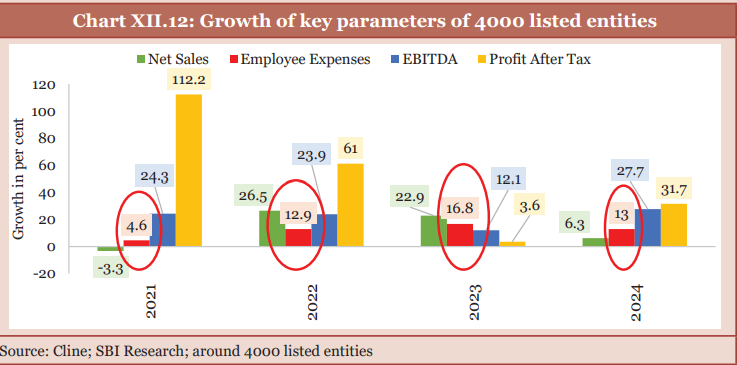
For workers, the distinction between nominal and real wage growth is equally important. A salary increase does not necessarily improve purchasing power when the cost of food, housing, transport and other essentials is rising. Financial Express, citing Annual Survey of Industries data, reported that factory-worker wages increased 5.3% in FY25, against household inflation of 4.6%, leaving real wage growth at approximately 0.7%.
Where Are Companies Directing Their Profits?
Rising profits do not automatically translate into money available for salary increases. Companies must account for taxes, debt repayments, raw materials, operating costs and investment requirements. However, their financial statements can reveal how they allocate additional earnings. Employee expenses, dividends, share buybacks, capital expenditure and retained earnings offer different ways of examining corporate priorities. Financial Express reported that an analysis of 4,046 companies found net profits increased nearly 19% in FY26, while wage bills grew by 9%. Corporate cash balances reached Rs 12.8 lakh crore by September 2026, their highest level in five years.
The figures raise questions about whether businesses are retaining a greater share of their earnings instead of directing more resources towards employees. They also invite scrutiny of shareholder payouts and investment decisions.
Cash accumulation alone does not establish that companies are avoiding recruitment or wage increases. Businesses may retain funds to manage uncertainty, reduce debt or finance future expansion. But when employee compensation consistently grows more slowly than profits, the distribution of corporate earnings deserves closer examination.
More Productivity, But Not Proportionately More Jobs?
Another explanation for the widening gap lies in how companies are increasing productivity. Businesses can expand output and revenue without increasing their workforce at the same rate. Automation, technology adoption, outsourcing, contractual employment and improved capacity utilisation allow companies to generate more value from existing resources.
Also Read: Sheikh Hasina's Return Bid Exposes Bangladesh's Unfinished Political Transition
This raises questions about the nature of India's corporate expansion. If companies are becoming more productive but creating relatively few additional jobs, the gains may be accruing disproportionately to capital owners rather than workers. The manufacturing sector is particularly important to this debate. The Annual Survey of Industries tracks employment, wages, contract workers, fixed capital and gross value added. These indicators can help establish whether factories are expanding through additional recruitment or greater reliance on machinery and existing capacity.
Employment quality also matters. An increase in the number of people engaged by a company does not necessarily mean an equivalent increase in permanent jobs. Contractualisation and outsourcing can allow businesses to control labour costs while maintaining production. The question, therefore, is not simply how many people companies employ, but what kind of employment they create and how much they pay.
Are Shareholders Benefiting More Than Workers?
The widening gap between corporate profits and employee compensation also brings the relationship between shareholders and workers into focus. For listed companies, dividends and share buybacks are important ways of returning money to investors. These are legitimate financial decisions, but comparing their growth with employee expenses and capital expenditure can reveal where companies are directing their resources.
The Reserve Bank of India's analysis of listed non-government, non-financial companies during FY26 found that staff costs increased by 10.7% in manufacturing, 6.1% in IT and 9% in non-IT services. Manufacturing operating profit growth also improved to 10.3%.
The sectoral differences suggest that the wage-profit relationship is not uniform across Indian industry. Some businesses face higher input costs and weaker demand, while others have stronger operating margins. A company-wise comparison is therefore necessary to establish whether modest wage growth reflects genuine financial constraints or a preference for controlling labour costs.
Can Corporate Growth Deliver Broader Prosperity?
The 2019 corporate tax reduction, which lowered the base tax rate for existing domestic companies from 30% to 22%, was intended to improve India's investment climate and encourage private-sector expansion. However, the relationship between tax relief, investment and employment has remained an important subject of debate. Companies need financial strength to build factories, adopt technology and compete internationally. But profitability alone cannot establish whether economic growth is improving workers' lives.
The argument is not that every increase in profit must be matched by an identical increase in wages. Nor can businesses be expected to hire irrespective of demand or financial conditions. However, sustained differences between profitability, compensation and employment deserve scrutiny. PM Modi's remarks have brought the issue back into focus, but the larger question concerns corporate India's own choices. How much of the additional wealth generated by businesses is being invested in their workforce? How much is being returned to shareholders or retained within companies?
India's corporate growth story cannot be measured only through rising earnings and market valuations. It must also be assessed through the incomes companies provide, the employment they generate and the share of productivity gains that reaches their workers.