Trump's Tariff Pressure Has a Catch: The World Can Hurt America Too
Trump Tariff Threats and Global Trade: The Trump administration's latest tariff proposal raises a question beyond its trade dispute with India: how far can the United States use its economic power to make other countries change their industrial and trade policies?
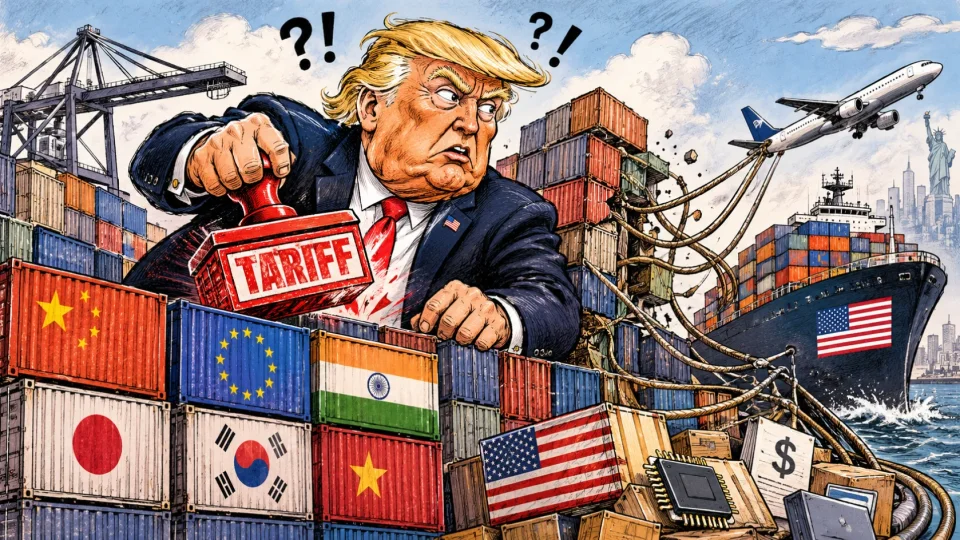
Trump Tariff Threats and Global Trade: The Trump administration's repeated use of tariffs raises an obvious question: if Washington keeps threatening its trading partners with higher duties, why do those countries not retaliate by simply stopping purchases of American goods and services? The question is particularly relevant after the United States Trade Representative (USTR) proposed additional tariffs of up to 25% on Indian goods on November 25, as part of an investigation targeting 14 economies. The proposal, which is not yet in force, also covers China, Japan, South Korea, Vietnam and the European Union. Washington says their industrial policies create excess manufacturing capacity and disadvantage American producers.
A collective boycott of American products might appear to be an effective response. But international trade is not a relationship between governments alone. It involves companies, consumers, financial institutions and supply chains that cannot be replaced by political decisions overnight. The cost of cutting those links would also fall on the countries attempting to retaliate.
Also Read: Congress-Meta Face-Off Puts Political Content Moderation Under Scrutiny
The issue, therefore, is not simply that America is powerful. It is how its economic relationships are structured, why other countries remain dependent on them, and what it would take to change that dependence.
1. The American Market is Difficult to Walk Away From
The first reason is the scale of American demand. According to the World Trade Organization's (WTO) Tariff and Trade Data profile, the US imported goods worth approximately $3.5 trillion in 2025. The European Union supplied $644 billion, China $327 billion, Taiwan $205 billion, Vietnam $201 billion, Japan $150 billion, South Korea $129 billion, India $108 billion and Switzerland $107 billion.
Together, these eight economies, all included in the latest USTR investigation, accounted for around $1.87 trillion, or more than 53% of US merchandise imports. This reveals an important part of the relationship. These countries do not just buy American products; they also depend on American consumers to purchase what they manufacture.
For an Indian textile exporter, a Japanese machinery producer or a Vietnamese electronics manufacturer, losing access to US buyers could mean losing a large and established market. Finding replacement customers in several countries is possible, but it takes time, new distribution networks and often different product standards. A government can announce a boycott more easily than its exporters can replace lost orders.
2. Stopping Purchases Would Also Hurt the Countries Doing the Boycotting
A blanket boycott would not automatically make American businesses suffer more than their foreign competitors. Take the example of a company that relies on US-made machinery, software, aircraft components or specialised technology. A government decision to stop purchasing these products would force the company to find substitutes. Those substitutes may be more expensive, less efficient or unavailable at the required scale.
The same issue applies to services. The US Bureau of Economic Analysis reported that American services exports reached $1.237 trillion in 2025. These included other business services, financial services and charges for the use of intellectual property. Replacing a supplier of a standard consumer product may be relatively straightforward. Replacing a service integrated into a company's financial operations, technology systems or licensing arrangements is more complicated. Contracts, compatibility, regulatory requirements and the availability of alternatives all affect the decision.
This is why governments may be willing to retaliate against selected American products but hesitate to prohibit all purchases from the US. The economic cost would not remain confined to Washington.
3. The Dollar Makes Economic Disengagement Even More Complicated
There is another layer to America's influence: the international financial system. The US dollar is not merely the currency used for buying American products. It is widely used for international trade invoicing, payments, foreign exchange transactions and financial reserves. This means countries can reduce purchases of American goods without necessarily reducing their dependence on the dollar.
Also Read: Trump Signals Meeting With El-Sayed Over ‘TrumpCare’ After Bitter Campaign Feud
An International Monetary Fund (IMF) working paper published in September 2025, based on data from 132 countries, found that the dollar remained dominant in global trade invoicing. The use of the Chinese renminbi had expanded, but remained modest. The paper also found that countries not geopolitically aligned with the US continued to rely on the dollar.
This does not mean the world cannot reduce its reliance on the dollar. It means that changing the currency used to conduct international transactions requires more than a political announcement. Alternative currencies need liquid financial markets, reliable payment networks and the confidence of businesses and central banks. De-dollarisation and a boycott of American products are therefore two different processes. Neither can be achieved simply by a government instructing its citizens to stop buying US goods.
4. Countries Have Retaliated, But Usually Selectively
The argument that the US can threaten tariffs without facing consequences is not supported by its own trade history. During the 2018-19 US-China trade conflict, China imposed retaliatory tariffs on American agricultural products, particularly soybeans. According to a May 2025 report by the US Congressional Research Service, the value of US soybean exports to China fell by 74% in 2018 compared with 2017. Between 2009 and 2017, China had accounted for nearly 60% of US soybean exports by value on average. Other markets increased their purchases, but could not fully replace the lost Chinese demand.
The consequences reached American farmers. The Congressional Research Service said the US Department of Agriculture used around $25.7 billion through three programmes to provide income support, purchase commodities and support trade promotion in response to retaliatory tariffs during 2018 and 2019.
This is an important distinction. Countries did not have to stop all purchases from America to impose costs on its exporters. They targeted products for which alternative suppliers were available and where the economic and political consequences would be visible. Such targeted retaliation is often more practical than a blanket boycott.
5. Tariffs Can Also Make American Businesses and Consumers Pay
The assumption that tariffs hurt foreign exporters alone is equally misleading. A tariff is collected from the importer bringing the goods into the country. Whether the cost is then absorbed by the importer, passed on to consumers or partly absorbed by the foreign seller depends on market conditions. Research on the 2018 US-China trade war found that American importers and consumers bore most of the initial tariff costs. A study by Mary Amiti, Stephen Redding and David Weinstein, published in the Journal of Economic Perspectives, estimated that the tariffs had reduced US real income by $1.4 billion per month by the end of 2018.
A separate study by the Federal Reserve's Aaron Flaaen and Justin Pierce found that, in manufacturing industries more exposed to tariff increases, the costs of imported inputs and foreign retaliation outweighed the employment benefits of import protection. This matters because American manufacturers are also part of global supply chains. If imported components become more expensive or foreign buyers turn to alternative suppliers, US businesses can lose competitiveness. Tariffs can protect one domestic industry while imposing costs on another.
The strategy, therefore, is not cost-free even for the country imposing them.
6. Why Can't the 14 Economies Act Together?
The final obstacle is political coordination. The 14 economies targeted by the USTR do not have identical trade interests. China competes with India and Vietnam in several manufacturing sectors. Japan and South Korea have close economic and security relationships with the US. The European Union has its own trade priorities, while India's negotiations with Washington are shaped by different market-access concerns.
Each has an incentive to negotiate a favourable deal rather than risk losing market access in support of a collective boycott. A country that secures a tariff exemption while its competitors remain exposed could even gain an advantage. The US can exploit these differences by negotiating separately and offering different tariff arrangements. The result is that countries may resist Washington's demands individually without necessarily forming a united front. This is not the same as accepting America's trade policy. It is a calculation about the cost of confrontation.
The World May Not Boycott America, But It can Reduce Its Dependence
A global boycott of American goods is unlikely to be the immediate response to Trump's tariff threats. The obstacles are practical as much as political: the size of the US market, dependence on American services and technology, the dollar's role in international finance, and the cost of replacing existing suppliers. But this does not leave other countries without options. They can impose targeted retaliatory tariffs, challenge trade measures through the WTO, diversify export destinations, encourage alternative suppliers and reduce dependence on American technology and financial infrastructure over time.
The US itself exported goods and services worth $3.43 trillion in 2025, according to the Bureau of Economic Analysis. Its overseas customers matter, even if a coordinated boycott would be difficult to organise.The more frequently Washington uses access to its market as a negotiating weapon, the stronger the incentive for other economies to build alternatives. That process will be gradual, uneven and expensive, but it can weaken American leverage over time.
The world does not continue buying American goods because it has no choice. It does so because replacing those relationships carries costs of its own. Trump's tariff strategy relies on that dependence. But the more Washington uses it as a weapon, the more reason other countries have to reduce it.