Stalin's Change of Stand on Delimitation: What Changed Between April and November?
Stalin DMK Delimitation and INDIA Bloc: The DMK's decision to back the Centre's proposed delimitation legislation has put M K Stalin in an uncomfortable position within the INDIA bloc. While Rahul Gandhi wants him to join the Opposition in defeating the bills, Stalin insists that his party's support is a victory for Tamil Nadu. The disagreement has exposed a larger political fault line over federalism, electoral representation and the future of Opposition unity.
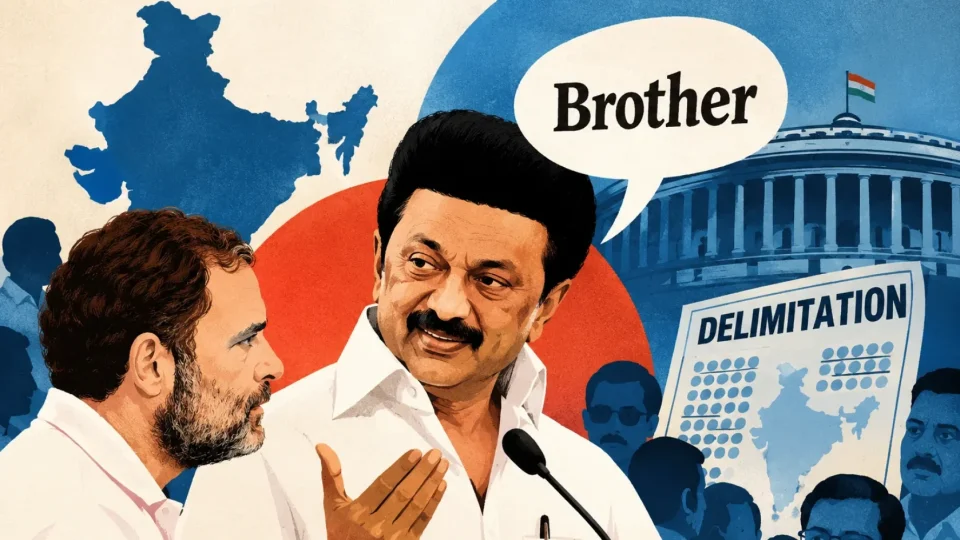
Stalin DMK Delimitation and INDIA Bloc: Former Tamil Nadu Chief Minister M K Stalin on Sunday thanked "brother" Rahul Gandhi after the Congress leader urged him to oppose the delimitation bills, cleared by the Union Cabinet and scheduled to be tabled in Parliament on November 30. The proposed exercise could redraw India's electoral map by creating new combinations of existing constituencies. Opposition leaders, activists and experts fear that the changes could favour the ruling Bharatiya Janata Party (BJP).
Responding to Gandhi, Stalin said the DMK had always placed Tamil Nadu's interests first and would not compromise on protecting the state. He expressed confidence that history would remember the party as "Kattabommans and not Ettappans", invoking the image of resistance rather than betrayal.
Gandhi, meanwhile, said senior INDIA bloc leaders would travel to Chennai to urge Stalin and the DMK to oppose the bills. Warning that expanding the Lok Sabha to 850 seats could "finish democracy in India", he alleged that the move would give the BJP-RSS room to redraw the electoral map to their advantage. He also praised Stalin for standing against what he described as anti-Tamil forces.
My sincere thanks to brother @RahulGandhi for acknowledging the DMK’s historic role in protecting the Constitution and the rights of the States. We have always made every decision keeping the interests of Tamil Nadu and our Tamil people as the foremost consideration. We will not compromise on this path and I’m confident that history will judge us as Kattabommans and not Ettappans.
— M.K.Stalin (@mkstalin) November 29, 2026
Stalin had opposed the earlier bill, arguing that a population-based delimitation exercise could reduce the relative representation of southern states while increasing the share of seats held by more populous northern states, including Uttar Pradesh and Madhya Pradesh. The Constitution (131st Amendment) Bill was defeated in the Lok Sabha in April, falling 54 votes short of the required special majority. The Opposition had argued that a united front was necessary to prevent its passage.
The political equation has since changed. The DMK has backed the revised proposal, which it says incorporates safeguards for Tamil Nadu. Its 22 Lok Sabha MPs could also prove significant to the government's numbers. Stalin's decision has placed him at the centre of a disagreement within the INDIA bloc. The question is whether a regional party can support national legislation on the grounds that it protects its state's interests, even when its principal political ally believes the proposal threatens democratic representation.
Why has Stalin Decided to Support the Revised Proposal?
The DMK's position stems from a dispute that has been building since 2024: how can parliamentary representation be expanded without disadvantaging states that have made progress in controlling population growth? Tamil Nadu has long argued that a delimitation exercise based primarily on population could reduce the relative influence of southern states. These states have invested in education, healthcare and family planning, and have generally experienced slower population growth than several northern states.
Also Read: BJP Known for Its Grassroots Work: Why Did It Struggle to Translate That Into Votes in Rajasthan?
The concern is that states with larger populations could gain a greater share of parliamentary seats, leaving southern states with a smaller proportion of representation in national decision-making. The DMK opposed the earlier proposal on these grounds. In 2024, the Tamil Nadu Assembly also passed a resolution seeking safeguards against any reduction in the state's parliamentary representation.
The revised proposal appears to address two of the party's principal demands:
-
A uniform 50 per cent increase in Lok Sabha seats across states and Union Territories.
-
Retention of the existing inter-state allocation ratio, based on the 1971 Census, until 2051.
The proposed exercise would use the 2011 Census to redraw constituencies while preserving the relative allocation of seats between states. For the DMK, this distinction is central. The party argues that Tamil Nadu can gain additional seats without losing its relative share of representation. It has cited an increase in its share of Lok Sabha representation from 7.18 per cent to 7.21 per cent as evidence that its demands have been addressed.
Stalin has therefore framed the decision as the result of sustained political pressure, rather than a reversal of the DMK's position. In his assessment, rejecting the revised proposal would mean giving up safeguards the party had spent years seeking.
Why is Rahul Gandhi Urging Stalin to Oppose the Bills?
The Congress argues that the revised proposal does not resolve all the concerns surrounding delimitation. Its objections extend beyond the distribution of seats between states to the process through which constituency boundaries will be redrawn. On November 29, Rahul Gandhi said senior INDIA bloc leaders would travel to Chennai to meet Stalin and urge the DMK to oppose the constitutional amendment bills.
Gandhi warned that expanding the Lok Sabha to 850 seats could allow the BJP and RSS to redraw India's electoral map to their political advantage. He argued that the consequences would extend beyond Tamil Nadu and affect democratic representation across the country. The Congress's concern is that increasing the number of seats does not, by itself, guarantee a fair delimitation exercise. Questions remain over how constituencies will be drawn, how communities will be represented and what safeguards will ensure the process is transparent and politically independent.
A delimitation commission's decisions can shape electoral representation for years. The manner in which it is constituted, the methodology it follows and the scope for public consultation are therefore significant. The Congress also wants the Opposition to maintain a common position on an issue it considers central to federalism and democratic representation. Stalin's support for the revised proposal complicates that effort.
Why has the Disagreement Become a Test of INDIA Bloc Unity?
The DMK is an important INDIA bloc partner, particularly in southern India. Its parliamentary strength gives its position significance beyond the immediate dispute with the Congress. The party has 22 members in the Lok Sabha and eight in the Rajya Sabha. While its support cannot secure the bills' passage on its own, it could influence the government's legislative arithmetic.
A constitutional amendment requires a special majority in each House of Parliament. Where applicable, it must also be ratified by at least half of the state legislatures. The disagreement reflects a broader challenge for the INDIA bloc: its constituent parties may share an opposition to the BJP but differ when a national policy has direct consequences for their respective states.
For the DMK, the immediate priority is protecting Tamil Nadu's share of parliamentary representation. The Congress, meanwhile, argues that the wider implications of the proposed exercise cannot be addressed through safeguards for individual states alone. The two positions are not necessarily incompatible. However, they reflect different assessments of the risks involved. The Congress wants a united Opposition against the bills, while the DMK believes the revised proposal incorporates the safeguards it had demanded. The proposed meeting with Stalin is therefore an attempt to prevent this disagreement from developing into a larger rift within the alliance.
Kattabomman Versus Ettappan: Why Stalin's Response Matters
The political disagreement took a sharper turn on November 29, when Stalin responded to Rahul Gandhi's appeal by invoking two historical figures from Tamil Nadu. Gandhi had used the term Ettappan, commonly associated in Tamil political discourse with betrayal, to warn against supporting delimitation at the cost of Tamil Nadu's interests. Stalin rejected the suggestion, saying: "We will not compromise on this path and I'm confident that history will judge us as Kattabommans and not Ettappans."
He also thanked Gandhi for recognising the DMK's role in protecting the Constitution and the rights of states. The reference to Veerapandiya Kattabomman, who resisted the East India Company's authority in the late eighteenth century, was politically significant. Stalin was presenting the DMK's decision as an assertion of Tamil Nadu's interests, not a compromise with the Centre.
The exchange also revealed how the two leaders could invoke the same principle of protecting Tamil Nadu while reaching different conclusions. Gandhi believes opposing the bills is necessary to protect democratic representation. Stalin argues that supporting the revised proposal is justified because it incorporates safeguards sought by the state.
5. Is Stalin Prioritising Tamil Nadu Over Opposition Unity?
Stalin's decision highlights the tension between regional political commitments and national alliances. Regional parties such as the DMK have built their political identities around state autonomy, linguistic identity and resistance to excessive centralisation. Their national alliances matter, but their credibility at home also depends on demonstrating that they can defend their state's interests.
Had the DMK opposed the revised proposal alongside the Congress, it could have strengthened the INDIA bloc's united position. But it would also have meant rejecting a proposal that the party claims addresses its principal concerns about Tamil Nadu's representation. Backing the bills allows Stalin to present the DMK's campaign as having secured a tangible outcome. At the same time, it exposes the party to criticism that it is helping the BJP-led government advance legislation that much of the Opposition considers dangerous.
The question, therefore, is not simply whether Stalin is siding with the BJP or the Congress. It is whether the safeguards secured by the DMK are sufficient to address the wider concerns raised by the proposed constitutional changes.
What Does the Controversy Mean for the Delimitation Debate?
Stalin's position has brought a central question into focus: are safeguards for individual states enough when the proposed legislation could reshape India's electoral representation? The expansion of the Lok Sabha, the use of the 2011 Census to redraw constituencies and the continuation of the 1971-based inter-state allocation ratio until 2051 are connected aspects of the proposal. But they raise distinct questions about representation, boundaries and the process of decision-making.
The government presents the legislation as a way to expand representation and implement women's reservation. The Opposition wants greater scrutiny of the process, its institutional safeguards and its potential political consequences. Its demands for a caste census and a bipartisan approach reflect concerns that decisions affecting representation require wider consultation.
Stalin's support has complicated the Opposition's attempt to build a common front. It has also shown that regional parties may make different calculations when they believe their state's interests are directly at stake. The DMK's argument is that it has secured protection for Tamil Nadu without abandoning its position on federalism. Whether those safeguards adequately address the broader concerns surrounding delimitation will be a key question when Parliament takes up the bills.
Stalin is at the centre of the controversy because his decision has turned delimitation from a confrontation between the government and the Opposition into a test of how regional parties balance state interests with national political commitments.