Reading Into PM Modi's GTA V Meme About Transformation During His 13-Year Regime
PM Modi GTA V Meme Post: The Prime Minister's post draws on the 13-year gap between the two Grand Theft Auto releases, using five indicators to present changes in India's economic standing, extreme poverty levels, sanitation coverage, solar power capacity and private space startup ecosystem. The comparisons also offer a glimpse into how the Modi government is framing its development record on social media.
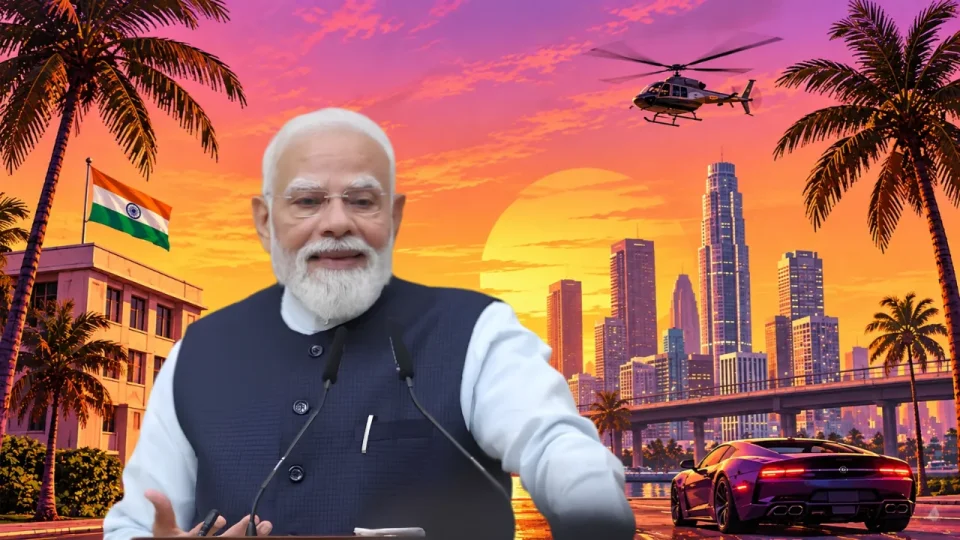
PM Modi GTA V Meme Post: Prime Minister Narendra Modi on Thursday used the launch of Grand Theft Auto VI (GTA 6), one of the most anticipated video game releases in recent years, to highlight changes in India's economy, infrastructure and technology over the past 13 years. Drawing a comparison between the release of GTA V in 2013 and GTA VI in 2026, Modi shared a series of graphics presenting his government's account of India's development during this period.
"India is playing a whole new game!" Modi said in a post on X, sharing colourful illustrations inspired by the popular gaming franchise. Titled 'Between GTA V and VI, here's how India upgraded', the graphics compare India's position across five sectors: economic growth, poverty, sanitation, solar energy and space technology.
The 13-year interval between the two games broadly overlaps with Modi's time as Prime Minister, although he assumed office in May 2014. The comparison uses this timeline to present developments since 2013 under his leadership.
India is playing a whole new game! https://t.co/CMkMbK6vII
— Narendra Modi (@narendramodi) November 19, 2026
'Fragile Five'
One graphic contrasts India's association with the 'Fragile Five' economies in 2013 with its current position as the world's fastest-growing major economy. The term 'Fragile Five' was coined in 2013 to describe emerging economies considered vulnerable to external financial pressures and fluctuations in foreign investment. India was included alongside Brazil, Indonesia, South Africa and Turkey.
The graphic uses this contrast to highlight India's changing economic position. Over the past decade, the country has recorded substantial economic growth, supported by domestic consumption, infrastructure spending and expansion in the services and digital sectors. However, questions around employment, income inequality and the distribution of economic gains remain relevant to assessing the broader picture.
Extreme Poverty: From 27% to 2.6%
Another graphic claims that extreme poverty in India has declined from 27% in 2013 to 2.6% in 2026. It illustrates the comparison through images of thatched houses and a modern home. Poverty reduction has featured prominently in the government's development narrative, with welfare schemes, direct benefit transfers, housing programmes and financial inclusion among the measures cited by the Centre.
However, poverty estimates vary according to the poverty line, methodology and reference period used. The figures in the graphic therefore need to be considered alongside their underlying data and definitions. They also do not capture every aspect of deprivation, including income insecurity, access to quality healthcare and education, and employment conditions.
Sanitation Coverage Rises from 39% to 100%
The post also claims that sanitation coverage has increased from 39% to 100%. The comparison is linked to the Swachh Bharat Mission, launched in October 2014 to improve sanitation access and eliminate open defecation through toilet construction and public awareness campaigns.
Also Read: Delhi Chokes Under Poor Air as AQI Hits 289; JNU, Pusa and Sirifort Record ‘Very Poor’ Pollution
The programme has been a major part of the government's rural development and public health agenda. However, sanitation coverage figures alone do not establish the quality or sustainability of the facilities. Their regular use, maintenance, water availability and waste management are also important measures of progress.
Solar Capacity Expands From 2.82 GW to 175 GW
A separate graphic highlights the expansion of India's solar energy capacity, from 2.82 GW in 2013 to 175 GW in 2026. India's solar sector has expanded through government incentives, private investment and the development of large-scale solar parks. The growth is part of the country's efforts to diversify its energy mix and increase the share of non-fossil fuel sources.
While installed capacity is an important indicator, the expansion of renewable energy also depends on transmission networks, energy storage and grid integration. The figure in the graphic should also be distinguished from India's total renewable energy capacity.
Space Startup Ecosystem Grows From One to 440
The final comparison focuses on the growth of India's private space sector. According to the graphic, the number of space startups has increased from one in 2013 to 440 in 2026. India's space programme was traditionally led by the Indian Space Research Organisation (ISRO), with limited private sector participation. The establishment of the Indian National Space Promotion and Authorisation Centre (IN-SPACe) in 2020 marked a step towards opening the sector to private companies.
Also Read: India’s Eyes Over the Indian Ocean: Navy Marks 50 Years of Maritime Reconnaissance
Startups have since entered areas such as satellite manufacturing, launch vehicles and space-based services. The growth of this ecosystem forms part of India's efforts to expand domestic capabilities and attract private investment in space technology.
GTA 6 arrives after a 13-year wait
Modi's post coincides with the global release of GTA VI on November 19, 2026, 13 years after GTA V arrived in September 2013. Developed by Rockstar Games, the latest instalment returns to Vice City, a fictionalised version of Miami, and follows protagonists Jason and Lucia. The game is launching on PlayStation 5 and Xbox Series X|S.
The gap between the two releases has made GTA VI a major global entertainment event. Modi's post uses the occasion to connect a widely recognised cultural reference with the government's account of India's development.