Can the Supreme Court Regulate Election Freebies? The Constitutional Questions Behind a Long-Pending PIL
The Supreme Court has once again been urged to hear a long-pending PIL challenging election freebies. Beyond the political debate, the case raises a deeper constitutional question: Can courts regulate electoral promises, or does that power lie with Parliament, the Election Commission and ultimately the voters? By Mahima Katal New Delhi, July 17: For more than four years, one of the most politically sensitive constitutional questions before the Supreme Court has remained unresolved: Can...
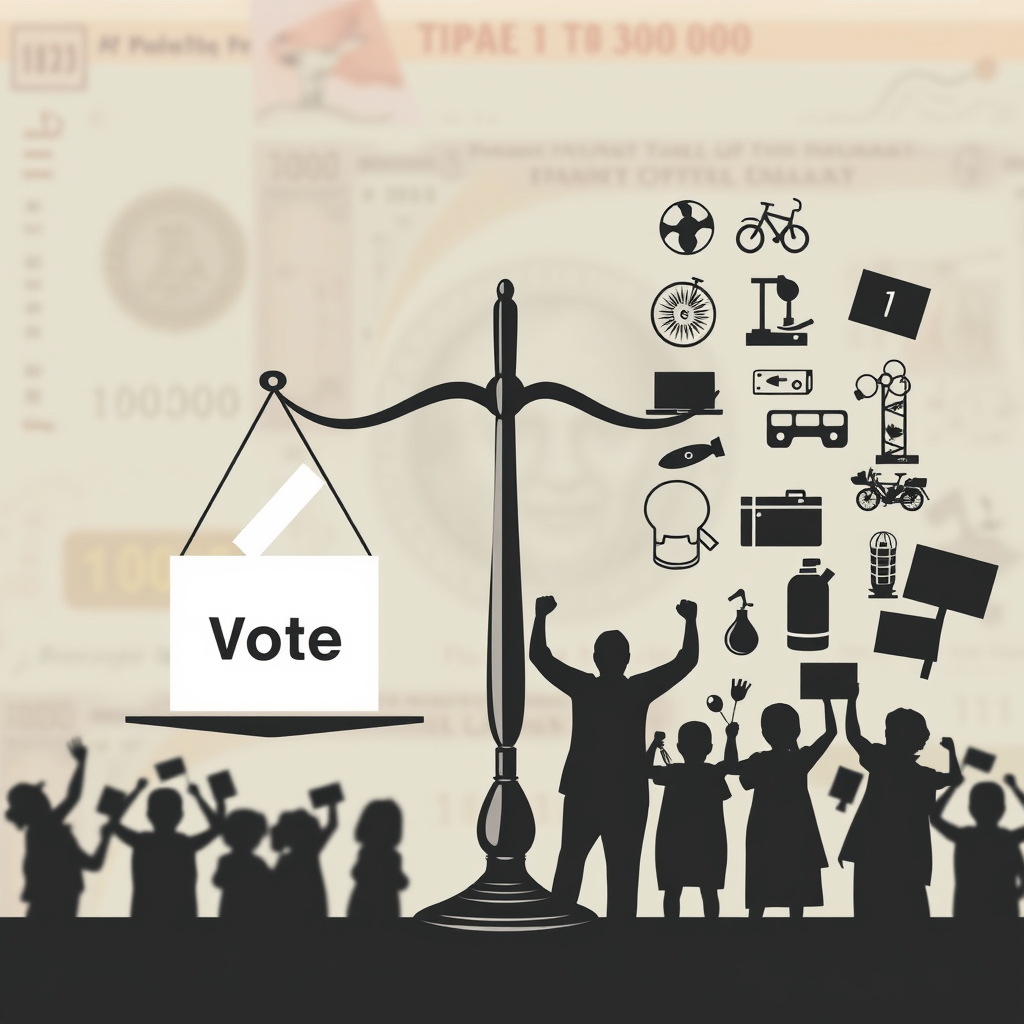
The Supreme Court has once again been urged to hear a long-pending PIL challenging election freebies. Beyond the political debate, the case raises a deeper constitutional question: Can courts regulate electoral promises, or does that power lie with Parliament, the Election Commission and ultimately the voters? By Mahima Katal New Delhi, July 17: For more than four years, one of the most politically sensitive constitutional questions before the Supreme Court has remained unresolved: Can courts regulate electoral promises made by political parties?
The issue resurfaced on Friday when advocate Ashwini Upadhyay urged the Supreme Court to urgently list a pending public interest litigation (PIL) seeking directions to deregister political parties or freeze their election symbols if they promise or distribute what the petition describes as "irrational freebies" before elections. While Chief Justice of India Surya Kant acknowledged the request, the Bench declined an immediate hearing, observing that the Court was currently "flooded with cases."
The exchange may have lasted only a few minutes, but it revived a debate that goes to the heart of India's constitutional democracy. The central question is no longer whether election freebies are fiscally prudent or politically desirable. It is whether the judiciary has the constitutional authority to regulate political manifestos without entering territory reserved for Parliament, the Election Commission and ultimately, the electorate.
A Case That Has Outlived Multiple Election Cycles
The petition has been pending since 2022, when a Bench led by then Chief Justice N.V. Ramana issued notices to the Union government and the Election Commission of India (ECI). During those proceedings, the Court described the issue as "serious" and even suggested that a committee comprising stakeholders could examine the matter.
Despite multiple mentions before the Court and several Assembly and general elections in the intervening period, no final hearing has taken place.
The petition seeks far-reaching directions. It asks the Court to direct the Election Commission to deregister or withdraw the election symbol of any political party that promises "irrational freebies" from public funds. Alternatively, it seeks a direction to Parliament to enact a law regulating such promises.
These prayers immediately raise a constitutional question: Can the Supreme Court compel either the Election Commission or Parliament to create new standards governing election manifestos?
The Missing Legal Definition
One of the most significant hurdles in the case is that Indian law contains no statutory definition of an "irrational freebie."
Political parties routinely promise welfare schemes, subsidies, cash transfers, loan waivers, free electricity, education assistance, healthcare benefits and social security measures. Some of these programmes are implemented through legislation and budgetary allocations after governments assume office.
Without a clear legal standard, distinguishing between a legitimate welfare policy and an unconstitutional electoral inducement becomes difficult.
The Constitution itself does not prohibit governments from spending public money on welfare schemes. On the contrary, the Directive Principles of State Policy encourage the State to promote social and economic justice.
The challenge, therefore, is determining whether an election promise is merely a policy proposal or an inducement that compromises the fairness of the electoral process.
The Election Commission's Limited Powers
The PIL also seeks directions requiring the Election Commission to amend the Election Symbols (Reservation and Allotment) Order, 1968 by introducing a condition that political parties must not promise irrational freebies.
However, this raises another institutional question.
The Election Commission undoubtedly enjoys wide powers under Article 324 of the Constitution to conduct free and fair elections. It also enforces the Model Code of Conduct during election periods.
But its authority is not unlimited.
The Commission cannot create substantive electoral offences without legislative backing.
Nor can it impose conditions that effectively alter statutory rights or disqualify recognised political parties unless authorised by law.
Whether Article 324 permits such regulatory expansion has repeatedly been debated before constitutional courts.
Where Does Judicial Review End?
The Supreme Court has often intervened to strengthen electoral integrity.
Its judgments have recognised the right of voters to know candidates' criminal antecedents and assets, required greater transparency in elections and interpreted constitutional provisions to reinforce democratic accountability.
Yet, the Court has also repeatedly cautioned against entering areas involving economic policy and legislative choices.
Election manifestos are fundamentally political documents. They reflect competing visions of governance, taxation and public expenditure. Determining whether a particular promise is fiscally responsible often involves complex economic assessments rather than purely legal questions.
If courts begin deciding which promises are constitutionally permissible, they may risk becoming arbiters of public policy instead of interpreters of law.
That concern explains why successive Benches have approached the freebies debate cautiously despite acknowledging its significance.
Welfare Versus Electoral Inducement
The debate is often framed as one between "freebies" and fiscal discipline. Constitutionally, however, the issue is more nuanced.
Governments routinely spend public resources on food security, education, pensions, healthcare and housing. These measures are often justified as fulfilling constitutional obligations under the Directive Principles.
Political parties, meanwhile, campaign on promises to expand or redesign such programmes.
The constitutional difficulty lies in identifying the point at which a welfare promise ceases to pursue a public purpose and instead becomes an impermissible inducement intended solely to influence voters.
That assessment may differ depending on economic conditions, legislative priorities and political ideology, factors that courts have traditionally been reluctant to evaluate.
Who Should Draw the Constitutional Line?
The long-pending PIL ultimately raises an institutional question as much as a legal one.
Should the Supreme Court define the limits of election promises?
Should Parliament enact legislation regulating manifestos?
Should the Election Commission receive broader statutory powers?
Or should voters remain the ultimate judges of political promises through the electoral process?
Each option carries constitutional consequences. Greater judicial intervention could strengthen electoral fairness but also invite criticism that courts are entering the political arena. Legislative regulation may provide democratic legitimacy but could itself become politically contentious. Expanding the Election Commission's authority would require carefully balancing regulatory independence with statutory limits.
More Than a Freebies Case
The Supreme Court's reluctance to rush into the matter reflects the complexity of the issue.
The case is not simply about subsidies or election promises. It concerns the constitutional boundaries between the judiciary, Parliament, the Election Commission and elected governments.
As political parties continue to compete through increasingly ambitious welfare commitments, the demand for legal clarity is unlikely to diminish. Whenever the Supreme Court finally hears the matter, its decision may shape not only the future of election manifestos but also the constitutional limits of judicial intervention in democratic politics.
The larger question is therefore not whether freebies should be regulated. It is who, under the Constitution, has the authority to decide where legitimate welfare ends and unconstitutional electoral inducement begins.