India and Canada Fast-Track ‘Game-Changer’ Trade Deal Talks
By Mahima Katal Commerce and Industry Minister Piyush Goyal on Tuesday expressed optimism that negotiations for the proposed India–Canada Free Trade Agreement (FTA), formally known as the Comprehensive Economic Partnership Agreement (CEPA), could be completed even before the end of 2026, potentially by October. Addressing a business event in Toronto during his three-day official visit to Canada, Goyal said officials from both countries are negotiating “with full sincerity” and working in...
By Mahima Katal
Commerce and Industry Minister Piyush Goyal on Tuesday expressed optimism that negotiations for the proposed India–Canada Free Trade Agreement (FTA), formally known as the Comprehensive Economic Partnership Agreement (CEPA), could be completed even before the end of 2026, potentially by October.
Addressing a business event in Toronto during his three-day official visit to Canada, Goyal said officials from both countries are negotiating “with full sincerity” and working in mission mode to conclude a comprehensive trade pact. He stated that both Indian and Canadian leadership have set an ambitious timeline for finalising the agreement.
Referring to discussions with Canada’s leadership, Goyal said that both he and Canada’s Trade Minister, Maninder Sidhu, have been tasked by their respective prime ministers to push the negotiations forward. According to him, Canadian Prime Minister Mark Carney had suggested concluding negotiations before the 2026 G20 Summit, scheduled for December 14–15 in Miami, United States. Goyal remarked that given the pace and sincerity of negotiations, an earlier conclusion remains possible.
The minister highlighted that India and Canada have also set an economic target of increasing bilateral trade from the current USD 17 billion to USD 50 billion by 2030. He identified key sectors where stronger collaboration could emerge, including innovation, seafood, education, finance, insurance, biotechnology, pharmaceuticals, energy, and technology.
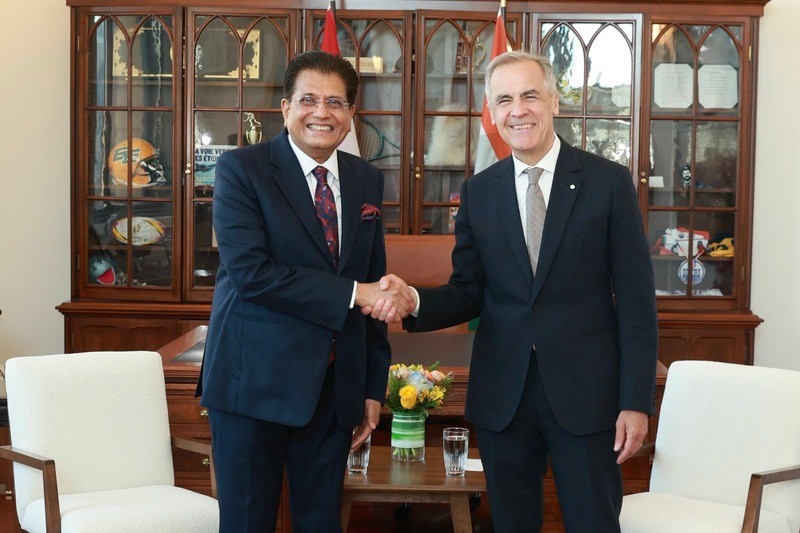
During his visit, Goyal met Prime Minister Carney in Ottawa, where both sides expressed confidence about achieving an early conclusion of the agreement. In a social media post, Carney described the proposed trade deal as a “game changer” for Canadian workers and businesses and pointed to opportunities in sectors such as energy, agri-food, technology, and education.
Negotiations for CEPA are currently underway in Ottawa, with the third round taking place from May 25 to 29 after two earlier rounds had already been completed. Such agreements generally aim to significantly reduce or eliminate import duties across traded goods while easing norms for services and investment flows.
Goyal is leading a large Indian business delegation comprising representatives from more than 100 companies across sectors including energy, mining, automotive goods, education, pharmaceuticals, telecommunications, artificial intelligence, leather, and textiles. Addressing industry leaders, he underlined India’s strengths as a rapidly growing economy with a workforce and a consumer base of approximately 1.4 billion people.
He also proposed expanding cooperation beyond trade, suggesting that India’s digital public infrastructure, including UPI, could help lower transaction costs in Canada. Additionally, he noted that Canada’s reserves of critical minerals could support India’s ambitions to strengthen manufacturing in electric vehicles and electronics.
On education, Goyal proposed exploring dual-degree programmes and eventually opening campuses of leading Indian institutions in Canada while inviting Canadian educational institutions to operate in India. He announced that Canada’s trade minister is expected to visit India in November this year.
Calling for a renewed partnership, Goyal urged both countries to move beyond recent tensions and rebuild trust. He said that economic cooperation and political engagement should progress together and described the relationship as mutually beneficial.
The renewed momentum in negotiations is particularly significant because talks had been paused in 2023 following a diplomatic fallout after former Canadian Prime Minister Justin Trudeau alleged a possible Indian connection to the killing of Hardeep Singh Nijjar.
Relations began improving after talks between Prime Minister Narendra Modi and Prime Minister Carney on the sidelines of the G7 Summit 2025 in Canada in June 2025. Both countries officially announced the resumption of CEPA negotiations in November 2025.
India’s major exports to Canada currently include pharmaceuticals, iron and steel products, seafood, garments, electronics, and chemicals, while imports from Canada include pulses, coal, fertilisers, petroleum crude, and semi-precious stones. India also exports services such as telecommunications, computer services, and business services.
Canada continues to remain an important destination for Indian students and is home to more than 425,000 Indian students alongside a large Indian diaspora community.