India-UK Free Trade Agreement: What's Missing From India's 'Most Ambitious' Trade Deal?
India's landmark trade deal with the UK is now in force. But what does the India-UK CETA leave out? An analysis of the agreement's gaps, opportunities and long-term implications. By Mahima Katal New Delhi, July 15: The India–United Kingdom Comprehensive Economic and Trade Agreement (CETA), which came into force on July 15, has been hailed by both governments as a landmark in bilateral relations. Prime Minister Narendra Modi described it as a "significant moment" that would deepen economic...
India's landmark trade deal with the UK is now in force. But what does the India-UK CETA leave out? An analysis of the agreement's gaps, opportunities and long-term implications.
By Mahima Katal New Delhi, July 15: The India–United Kingdom Comprehensive Economic and Trade Agreement (CETA), which came into force on July 15, has been hailed by both governments as a landmark in bilateral relations. Prime Minister Narendra Modi described it as a "significant moment" that would deepen economic ties, while UK Prime Minister Keir Starmer earlier called it the beginning of "a new era for trade and the economy."
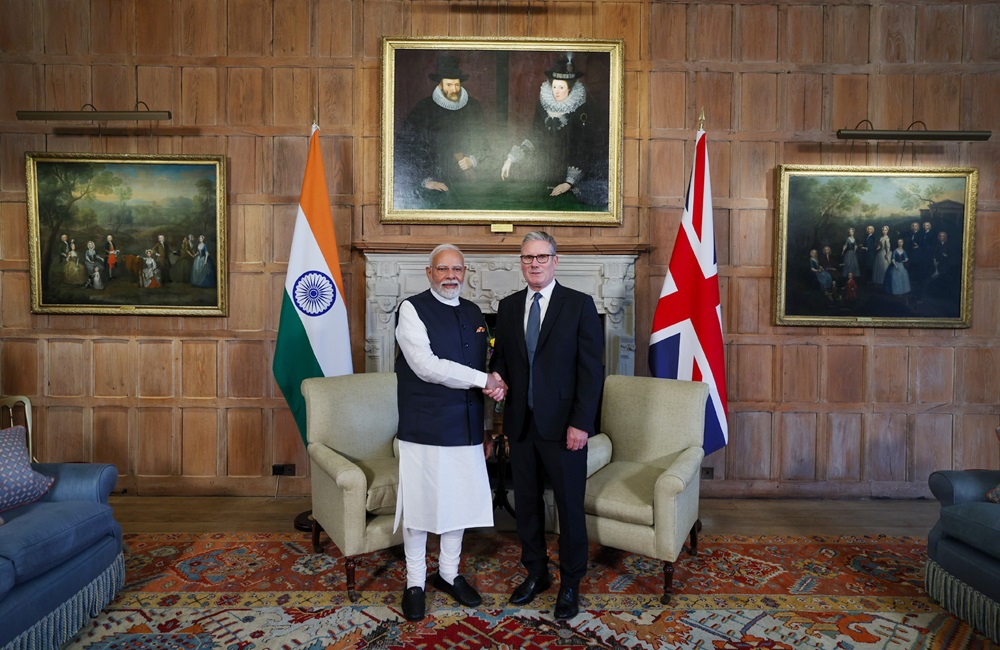
PM meeting with the Prime Minister of the United Kingdom, Mr. Keir Starmer at London, in England on July 24, 2025.
Union Commerce Minister Piyush Goyal has projected the agreement as transformational, highlighting duty-free access for nearly 99 per cent of India's exports, expanded opportunities for farmers, MSMEs and service providers, and relief for Indian professionals through a parallel Social Security Agreement.
On paper, the deal is among India's most ambitious free trade agreements with a developed economy. It covers almost the entire trade basket, opens new avenues for services and mobility, lowers tariffs across hundreds of products and signals India's willingness to engage more deeply with advanced economies after years of cautious trade negotiations.
Yet, like every major trade agreement, the real story lies not only in what has been included—but also in what has been deliberately left out.
A Trade Agreement, Not a Comprehensive Economic Partnership
Despite its broad scope, CETA does not attempt to solve every challenge in India-UK economic relations.
Several politically sensitive sectors remain protected.
India has excluded products such as fresh apples, walnuts, certain dairy products, seeds, smartphones and gold bars from tariff concessions. The United Kingdom has similarly protected products including rice, sugar, eggs and several meat products.
These exclusions reflect a familiar reality in international trade negotiations: free trade agreements rarely eliminate all trade barriers. Domestic political considerations continue to shape market access.
Limited Agricultural Liberalisation
Government statements have emphasised duty-free access for agricultural exports.
However, the agreement stops short of creating a completely open agricultural market.
Sensitive commodities—including rice, sugar, poultry, pork and eggs—remain outside the tariff liberalisation framework.
For India, this protects domestic producers from import competition. For UK exporters, it limits market access in sectors where political sensitivities remain high.
The result is an agreement that expands opportunities without fundamentally reshaping agricultural trade.
No Major Shift in Pharmaceutical Intellectual Property
One of the most closely watched aspects of any agreement involving a developed economy is intellectual property protection.
In previous negotiations, developed countries have often sought stronger patent protections, patent-term extensions and pharmaceutical data exclusivity.
India resisted those demands.
Under CETA, India has not accepted patent-term extensions or pharmaceutical data exclusivity. Equally significant, compulsory licensing, a critical public health safeguard allowing governments to authorise production of patented medicines during emergencies, remains intact.
For India's pharmaceutical industry, this represents continuity rather than change.
Services Liberalisation Remains Selective
India's comparative advantage lies in services rather than manufacturing.
While CETA expands opportunities for IT professionals, consultants, educators, financial service providers and certain skilled workers, it falls well short of providing unrestricted labour mobility.
The agreement creates quotas for chefs, yoga instructors and classical musicians and exempts temporary Indian workers from UK National Insurance contributions for up to five years.
However, immigration policy remains firmly under British domestic control.
Indian professionals will continue to require visas, satisfy licensing requirements and comply with UK immigration rules.
In other words, the agreement facilitates movement—but does not guarantee it.
Government Procurement Opens Only One Way
One of the agreement's more notable provisions allows UK firms access to approximately 40,000 high-value central government procurement contracts in India.
While this reflects India's willingness to open parts of its procurement market, questions remain about reciprocal opportunities.
Indian companies continue to face practical barriers in bidding for government contracts abroad, particularly in areas where procurement policies remain influenced by domestic industrial priorities.
Whether Indian firms derive comparable benefits will depend on implementation rather than treaty language alone.
Climate and Sustainability Receive Limited Attention
Modern trade agreements increasingly incorporate climate commitments, carbon adjustment mechanisms and sustainability obligations.
CETA contains cooperation provisions but stops short of establishing robust environmental enforcement mechanisms.
This omission may become increasingly relevant as carbon border adjustment measures and green industrial policies reshape international trade.
Indian exporters may still need to independently comply with evolving environmental standards imposed by developed markets.
Rules of Origin Could Become the Real Challenge
The agreement promises duty-free market access for almost all Indian exports.
Yet preferential tariffs are not automatic.
Exporters must satisfy detailed Rules of Origin requirements demonstrating that products genuinely originate in India rather than merely passing through the country.
For large exporters with established compliance systems, this may be manageable.
For MSMEs: the very businesses the agreement seeks to empower, documentation, certification and compliance costs could become significant hurdles.
The value of tariff concessions ultimately depends on whether businesses can actually utilise them.
Tariff Reduction Does Not Guarantee Export Growth
The agreement has generated considerable optimism around exports.
But trade economists caution that lower tariffs alone do not ensure greater competitiveness.
Indian exporters must still overcome challenges including logistics costs, infrastructure constraints, quality certification, regulatory compliance and supply chain efficiency.
Without addressing these structural issues, preferential tariffs may not translate into proportional export growth.
The experience of several earlier free trade agreements suggests that utilisation rates often remain below expectations, particularly among smaller firms unfamiliar with complex trade documentation.
The Steel Question Remains
Even as CETA enters into force, uncertainty persists in one important sector.
The United Kingdom has introduced a stricter steel import regime that could affect Indian steel exports despite the broader trade agreement.
This illustrates an important limitation of FTAs.
Trade agreements reduce tariffs, but they do not eliminate all non-tariff barriers, safeguard measures or domestic regulatory actions.
Consumer Gains Will Be Gradual
Indian consumers are expected to benefit from lower prices on products such as Scotch whisky, premium automobiles, cosmetics, chocolates and certain imported goods.
However, many tariff reductions will occur gradually over five to ten years rather than immediately.
For example, duties on Scotch whisky will decline in phases, while tariffs on fully built UK vehicles will reduce over several years under quota-based arrangements.
The headline numbers therefore mask a phased implementation process.
A Strategic Signal Beyond the UK
Perhaps CETA's greatest significance lies beyond bilateral trade.
The agreement signals a broader shift in India's trade policy.
After years of scepticism towards large trade blocs. including its decision to stay out of the Regional Comprehensive Economic Partnership (RCEP), India has increasingly pursued bilateral agreements with strategic partners such as the UAE, Australia, EFTA and now the United Kingdom.
In that sense, CETA serves as a template for future negotiations with the European Union and potentially other developed economies.
The India–UK Free Trade Agreement is undoubtedly one of India's most consequential trade agreements in recent years.
It expands market access, strengthens services cooperation, reduces tariffs across thousands of products and provides meaningful benefits for many exporters and professionals.
Yet it is not a comprehensive solution to every trade challenge.
Sensitive sectors remain protected. Labour mobility remains limited. Environmental provisions are modest. Compliance burdens persist. Market access will depend as much on businesses' ability to navigate rules of origin, certification and regulatory requirements as on the treaty itself.
The agreement marks the beginning of a new phase in India-UK economic relations, not the conclusion of it.
Whether it ultimately delivers on its promise will depend less on the text of the agreement and more on how effectively governments, exporters and industries implement it over the coming decade.