Land Deed, 1951 NRC, PAN, EPIC: Despite 15 Documents, Why Man in Assam Declared Foreigner?
The Gauhati High Court upheld a Foreigners Tribunal order declaring a man a foreigner, ruling that despite submitting 15 documents, he failed to establish an unbroken documentary link proving his Indian citizenship under the Foreigners Act.
The Gauhati High Court upheld a Foreigners Tribunal order declaring a man a foreigner, ruling that despite submitting 15 documents, he failed to establish an unbroken documentary link proving his Indian citizenship under the Foreigners Act.
By Pranjal Gupta
New Delhi, July 2: Upholding an order of the Foreigners Tribunal, the Gauhati High Court dismissed the plea of a man who had furnished 15 documents, including the 1951 National Register of Citizens (NRC), to prove that he is an Indian citizen.
While doing so, the high court observed that the burden of proving his Indian citizenship lay on him under Section 9 of the Foreigners Act, 1946. This means it was not for the State to prove that he was a foreigner.
The petitioner, Aminul Hoque, submitted before the court that around 56 or 57 years ago, his family shifted from Charai Khasara to village Dhobakura due to erosion caused by the Brahmaputra. His father purchased land in village Ghugudoba on September 12, 1973. About 37 years ago, following a family separation, he shifted from village Dhobakura to village Ghugudoba, and around 22 years ago, he moved to village Hashdoba. He also submitted a school certificate showing that he had studied in Class V at Hashdoba Anchalik High School in 1999.
However, the school certificate did not help his case because the person who had written or signed the certificate never appeared before the court to prove its authenticity.
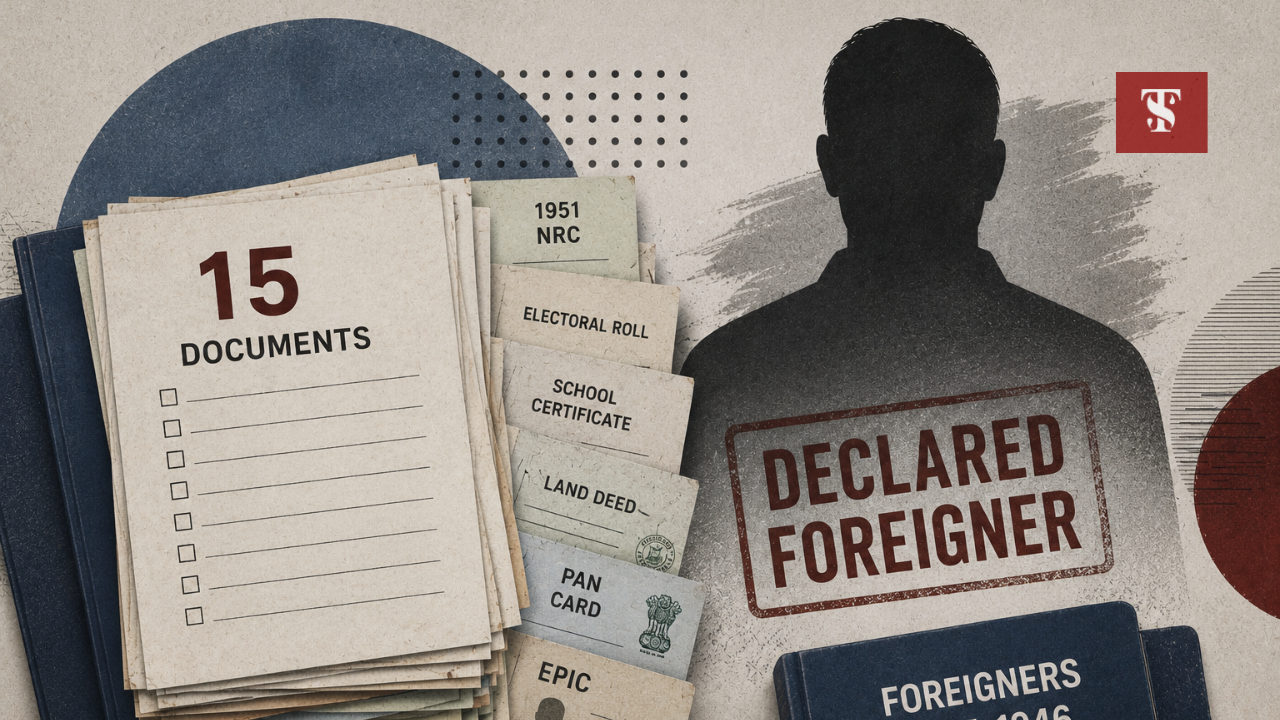
Gauhati High Court ruled that 15 documents, including the 1951 NRC, failed to establish the petitioner's claim of Indian citizenship. (AI-Generated Image)
Spelling Variations
He also submitted that both his parents and grandparents were registered in previous electoral rolls. But it also could not hold much ground as the High Court found variations in the name of the petitioner's father, ranging from Mohiruddin to Mohir Uddin Sheikh. However, it expressly stated that it would not take a "serious note" of these spelling variations.
Besides that, the court ruled that the overall documentary evidence failed to establish a consistent and unbroken linkage connecting him to his claimed ancestors.
'PAN Card, EPIC Do Not Prove Citizenship'
The petitioner produced the 1951 NRC, multiple electoral rolls, a school certificate, PAN card, Elector's Photo Identity Card (EPIC), a land deed and other documents to establish his citizenship.
The court also observed that it is well settled that a PAN card and an EPIC are not proof of citizenship. It noted that the petitioner had not produced any evidence to show that he was an income tax assessee. Therefore, the PAN card carried little evidentiary value, as it had been issued on the basis of the petitioner's self-declaration.
His land deed could not qualify too. The court said, "The Sale Deed dated 12.09.1973 (Ext.D) in respect of the land purchased by the petitioner’s projected grandfather was discarded as there was no explanation that if the land existed, why the land did not devolve on the legal heirs of petitioner’s grandfather."
"Thus, though the petitioner had exhibited 15 documents, the same do not appear to help the petitioner establish that he has been able to discharge his burden, as required under Section 9 of the Foreigners Act, 1946, to prove that he is not a foreigner but an Indian citizen," the court observed.