Not Even Landslides, Deaths or Building Collapses Stop Mumbaikars. And That's Not Something to Be Proud Of.
Mumbai's monsoon fury has crippled transport, claimed lives and exposed fresh cracks in the city's infrastructure. From the Missing Link landslide to deadly building collapses, the crisis has reignited questions over BMC's monsoon preparedness.
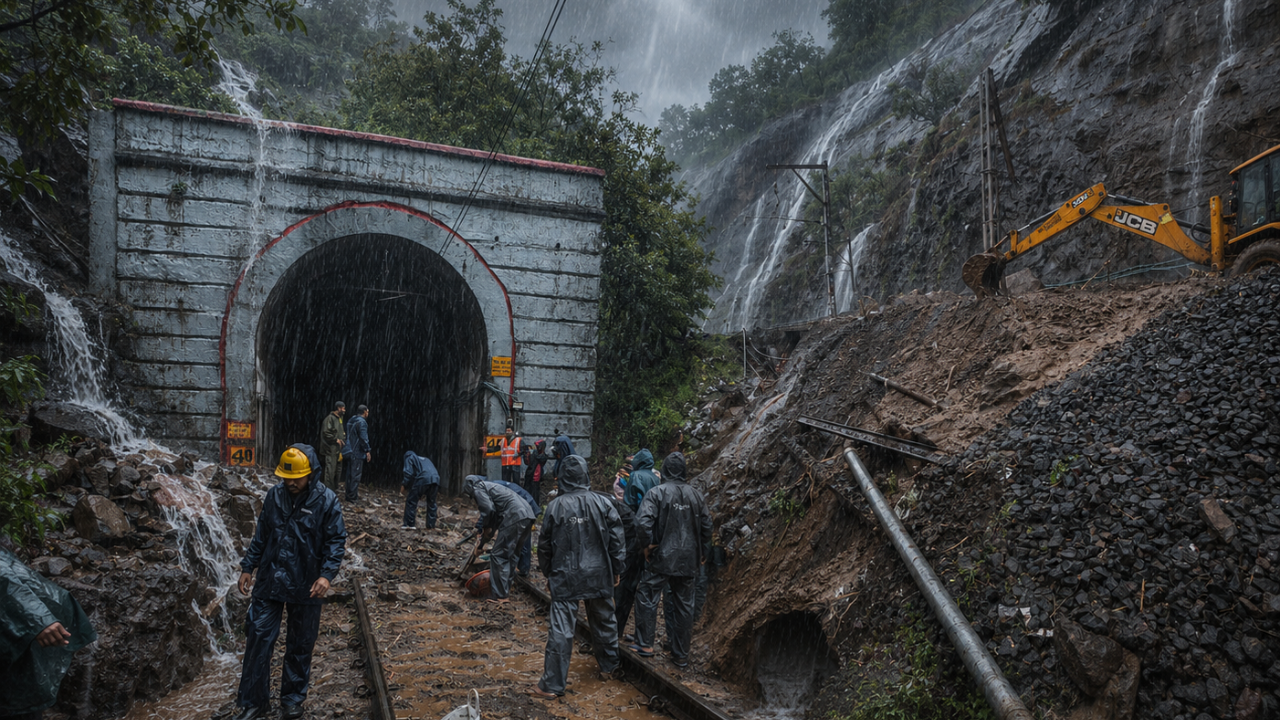
Mumbai's monsoon fury has crippled transport, claimed lives and exposed fresh cracks in the city's infrastructure. From the Missing Link landslide to deadly building collapses, the crisis has reignited questions over BMC's monsoon preparedness.
By Pranjal Gupta
New Delhi, July 6: "Despite adverse weather conditions and challenging terrain," Mumbai continues to wake up every morning and head to work. But this monsoon has once again exposed the city's fragile infrastructure, with landslides, building collapses, flooded roads and transport disruptions bringing India's financial capital to a near standstill.
Thousands of commuters remained stranded for hours after a landslide blocked the newly inaugurated Mumbai-Pune Expressway Missing Link. Debris from the Sahyadri hills accumulated near the exit of Tunnel 2, forcing authorities to divert traffic as a precautionary measure.
While the diversion was necessary for public safety, the incident has raised serious questions about the resilience of one of Maharashtra's most ambitious infrastructure projects. Opened barely two months ago, the Missing Link has already suffered a major disruption during its first monsoon.
As the expressway remained shut, tragedy unfolded within Mumbai. Late Sunday night, a three-storey chawl in Mandala locality collapsed after relentless rainfall triggered a land cave-in, killing six people. Maharashtra Chief Minister Devendra Fadnavis expressed grief over the incident and announced an ex gratia of Rs 5 lakh each for the families of the deceased.
"Despite adverse weather conditions and challenging terrain, restoration work at the landslide-affected section is progressing on a war footing. Railway teams, supported by heavy machinery, are clearing debris and working to restore services at the earliest," Maharashtra Chief Minister Devendra Fadnavis said.
The devastation has once again revived a familiar question: If the Brihanmumbai Municipal
Corporation (BMC) had claimed to be monsoon-ready, what went wrong?
Year after year, the civic body promises better drainage systems, improved flood management and stronger disaster preparedness. Yet every intense spell of rain continues to expose the city's vulnerabilities through waterlogging, transport paralysis, structural failures and loss of lives. For those who survive the immediate impact, stagnant floodwaters often bring another crisis in the form of water-borne diseases.
Disaster Management Minister Girish Mahajan said rain-related incidents across Mumbai, Palghar and Raigad have claimed 13 lives over the past four days. The toll has continued to rise, with another landslide in Pune claiming six more lives.
Meanwhile, the India Meteorological Department (IMD) has issued a Red Alert, urging people to step outdoors only when absolutely necessary.
When Staying Home Isn't an Option
For many professionals, working from home has become the safest response to extreme
weather. But for millions of Mumbaikars, staying indoors simply is not an option.
Daily wage labourers, street vendors, delivery executives, domestic workers, drivers, sanitation workers and countless informal-sector employees rely on each day's earnings to sustain their families. Missing work often means missing a day's income. For them, rain may be an inconvenience, but unemployment for even a day can become a financial crisis.
The BMC declared a holiday for schools and colleges, while several private companies and financial institutions in the Bandra-Kurla Complex (BKC) shifted to work-from-home arrangements, allowing much of the city's formal economy to continue functioning remotely.
However, Mumbai's vast informal workforce—the backbone of the city's everyday operations—continued to brave flooded streets, disrupted transport and dangerous conditions because earning a livelihood left them with little choice.
Even the legendary Mumbai Dabbawalas, globally recognised for their near-perfect delivery network, were forced to suspend operations for the day as rail services remained severely affected.
Yet the city's financial engine did not stop entirely. Online banking, digital payments, stock trading at the Bombay Stock Exchange and corporate communication platforms continued operating seamlessly through cloud-based infrastructure, allowing business operations to continue despite widespread physical disruption.
The BMC has urged residents to remain indoors, avoid coastal areas and exercise caution as emergency services brace for another spell of heavy rainfall and high tide.
Here's What Happened Despite BMC's Monsoon Preparations
Twin Lifelines Fractured: Ghat Landslides and Rail Suspensions
Mumbai's two crucial transport corridors connecting the city to the rest of Maharashtra suffered severe disruptions following multiple landslides in the Western Ghats.
Railway Network Hit
A massive landslide sent boulders and mud crashing onto railway tracks between Thakurvadi and Monkey Hill in the Karjat-Lonavala section, disrupting all three railway lines.
Central Railway cancelled 16 intercity trains, including the iconic Deccan Queen and Indrayani Express, while diverting nine long-distance services, affecting thousands of passengers.
Mumbai-Pune Expressway Missing Link Blocked
At around 4 a.m. on Monday, another landslide buried a section of the Khopoli-Kusgaon Missing Link near Tunnel 2 on the Mumbai-Pune Expressway.
Authorities immediately closed the Mumbai-bound carriageway and suspended vehicular movement until the debris could be cleared, causing massive traffic congestion on one of the state's busiest express corridors.
Inner City Chaos: 300 mm Rainfall Overwhelms Mumbai
Within city limits, relentless rainfall overwhelmed Mumbai's ageing civic infrastructure.
Over the past 24 hours, Vikhroli West recorded 310.6 mm of rainfall, while Colaba received 306.6 mm, making them among the worst-hit locations.
The heavy rain triggered multiple structural failures across the city.
A three-storey chawl collapsed in Mandala, killing six people, including five children, while more than 140 tree-fall incidents were reported across Mumbai. Fatalities were also reported from Kurla and parts of the western suburbs as falling trees and weakened structures added to the devastation.
Summary of Major Disruptions
SectorCurrent StatusImpactSuburban RailDelayed / Partial SuspensionServices running 6–8 minutes behind schedule on the Main Line; Karjat-Lonavala section severely disrupted.Long-Distance TrainsMajor DisruptionsSixteen trains cancelled and nine diverted following landslides in the ghat section.Air TrafficOperational DisruptionsChhatrapati Shivaji Maharaj International Airport temporarily suspended runway operations due to poor visibility and adverse weather.Road NetworkSevere CongestionMumbai-Pune Expressway Missing Link closed after landslide; old Mumbai-Pune Highway and several city subways waterlogged.
As Mumbai braces for more rainfall under an active Red Alert, the city's latest monsoon crisis has once again highlighted the widening gap between infrastructure promises and on-ground preparedness. While emergency teams continue restoration work, millions of residents remain caught between the need to stay safe and the necessity of keeping the city—and their livelihoods—running.
Basically, Mumbaikars have learnt to adjust to all the rain-related woes, as BMC's promises are the ones to collapse first.