North Korea Unveils New Uranium-Enrichment Facility, Signals Rapid Expansion of Nuclear Arsenal
By Mahima Katal North Korea has unveiled a new uranium-enrichment facility and announced plans to expand its nuclear forces “at an exponential rate,” underscoring the country's continued commitment to strengthening its nuclear weapons programme despite international sanctions and diplomatic pressure. The announcement was made through state-run Korean Central News Agency (KCNA) on Thursday after leader Kim Jong Un visited the facility to inspect its operations and review long-term production...
By Mahima Katal North Korea has unveiled a new uranium-enrichment facility and announced plans to expand its nuclear forces “at an exponential rate,” underscoring the country's continued commitment to strengthening its nuclear weapons programme despite international sanctions and diplomatic pressure.
The announcement was made through state-run Korean Central News Agency (KCNA) on Thursday after leader Kim Jong Un visited the facility to inspect its operations and review long-term production plans.
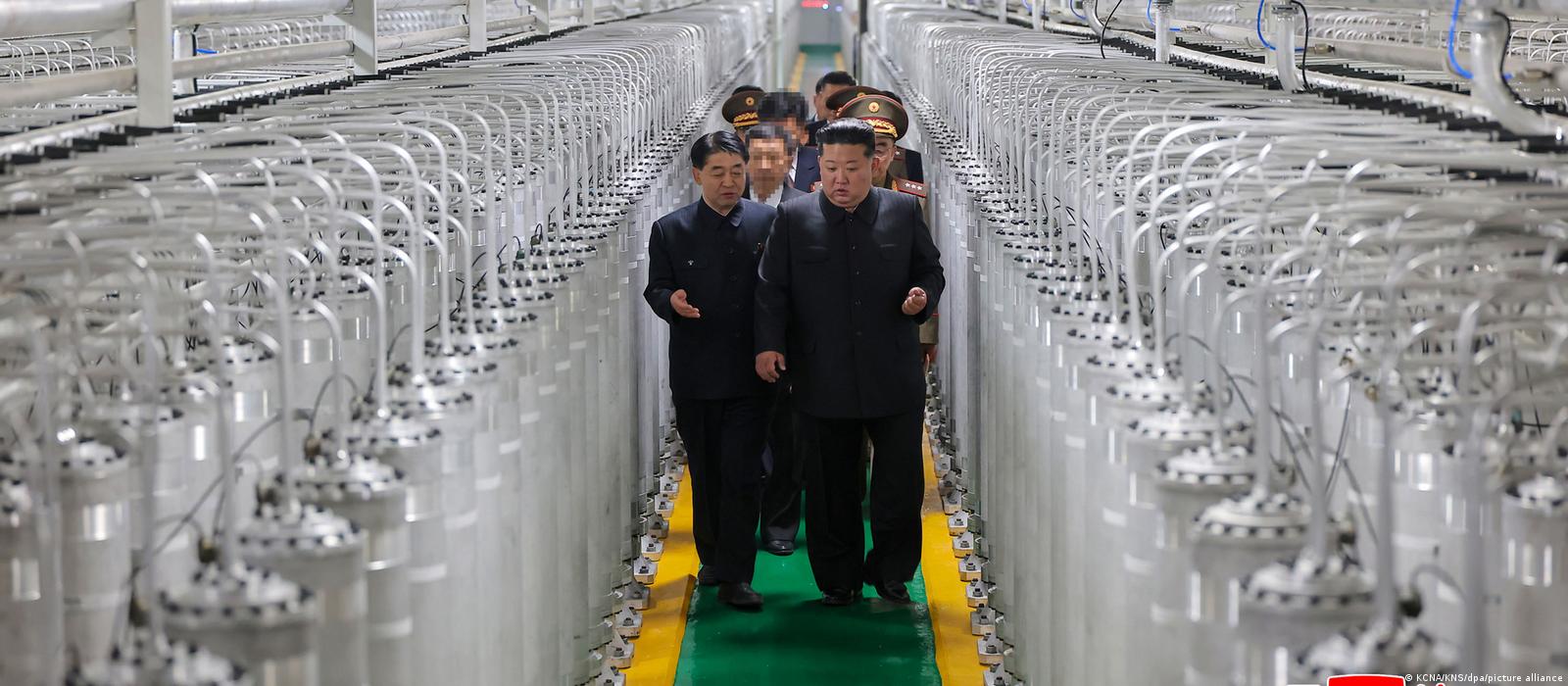
While North Korean authorities did not disclose the location of the facility or when it became operational, state media released photographs showing what appeared to be a large centrifuge hall. Centrifuges are used to enrich uranium, a process that can produce fuel for civilian nuclear reactors or, at higher levels of enrichment, material suitable for nuclear weapons.
South Korea's Joint Chiefs of Staff assessed the site as a uranium-enrichment plant and said Seoul was closely coordinating with the United States to monitor North Korea's nuclear activities.
According to KCNA, the newly unveiled facility employs “more sophisticated technology,” although no further details were provided.
Kim Calls for Expansion of Nuclear Deterrent
During the visit, Kim argued that growing security threats require North Korea to expand its nuclear capabilities both quantitatively and qualitatively.
KCNA quoted Kim as saying that the need to strengthen the country's nuclear deterrent had become more urgent due to confrontations with what he described as “the most ferocious enemies,” an apparent reference to the United States and South Korea.
Kim also claimed that North Korea's capacity to produce weapons-grade nuclear material has more than doubled over the past five years, a statement that could not be independently verified.
The North Korean leader said senior officials had approved priorities for implementing an ambitious plan aimed at significantly increasing the country's nuclear forces.
Continued Nuclear Build-Up
The disclosure marks the second time in less than two years that North Korea has publicly revealed a uranium-enrichment facility. In September 2024, Pyongyang unveiled another previously undisclosed enrichment plant, with Kim similarly calling for an expansion of centrifuge capacity to accelerate nuclear weapons production.
North Korea has not conducted a nuclear test since 2017, but it has continued to develop and test a wide range of nuclear-capable missile systems. Analysts say the country has focused on improving both the size and sophistication of its arsenal since negotiations with the United States collapsed in 2019.
The breakdown followed high-profile summits between Kim and then-U.S. President Donald Trump, which failed to produce an agreement on sanctions relief and denuclearisation.
Growing International Concerns
Experts differ on the size of North Korea's current nuclear stockpile. South Korean intelligence estimates previously suggested the country possessed between 20 and 60 nuclear weapons, though some analysts now believe the arsenal may exceed 100 warheads.
The exact number remains difficult to determine because of the secrecy surrounding North Korea's nuclear programme.
Last year, South Korean officials stated that North Korea was operating four uranium-enrichment facilities, including its main nuclear complex at Yongbyon.
In April, International Atomic Energy Agency (IAEA) Director General Rafael Grossi reported a “rapid increase” in activity at North Korean nuclear facilities, raising fresh concerns about the pace of the country's weapons development.
North Korea remains subject to multiple United Nations Security Council resolutions that prohibit the expansion of its nuclear weapons programme. However, Pyongyang has consistently defended its nuclear arsenal as essential for national security and has rejected calls to return to denuclearisation negotiations.
The latest announcement is likely to intensify concerns among regional powers and the wider international community, as it suggests North Korea is investing in the infrastructure needed to increase production of fissile material used in nuclear weapons.