The Prince And The President: How MBS Is Pushing Trump Toward Regime Change In Iran
The slate Bureau Saudi Arabia's most powerful man sees a rare historic window. But the risks of his gamble could reshape the entire region Behind the public statements and diplomatic niceties, a more urgent and consequential conversation has been unfolding between Riyadh and Washington. Saudi Crown Prince Mohammed bin Salman has been privately urging President Trump to press ahead with the military campaign against Iran, not merely to degrade its capabilities, but to bring down its government...
The slate Bureau
Saudi Arabia's most powerful man sees a rare historic window. But the risks of his gamble could reshape the entire region
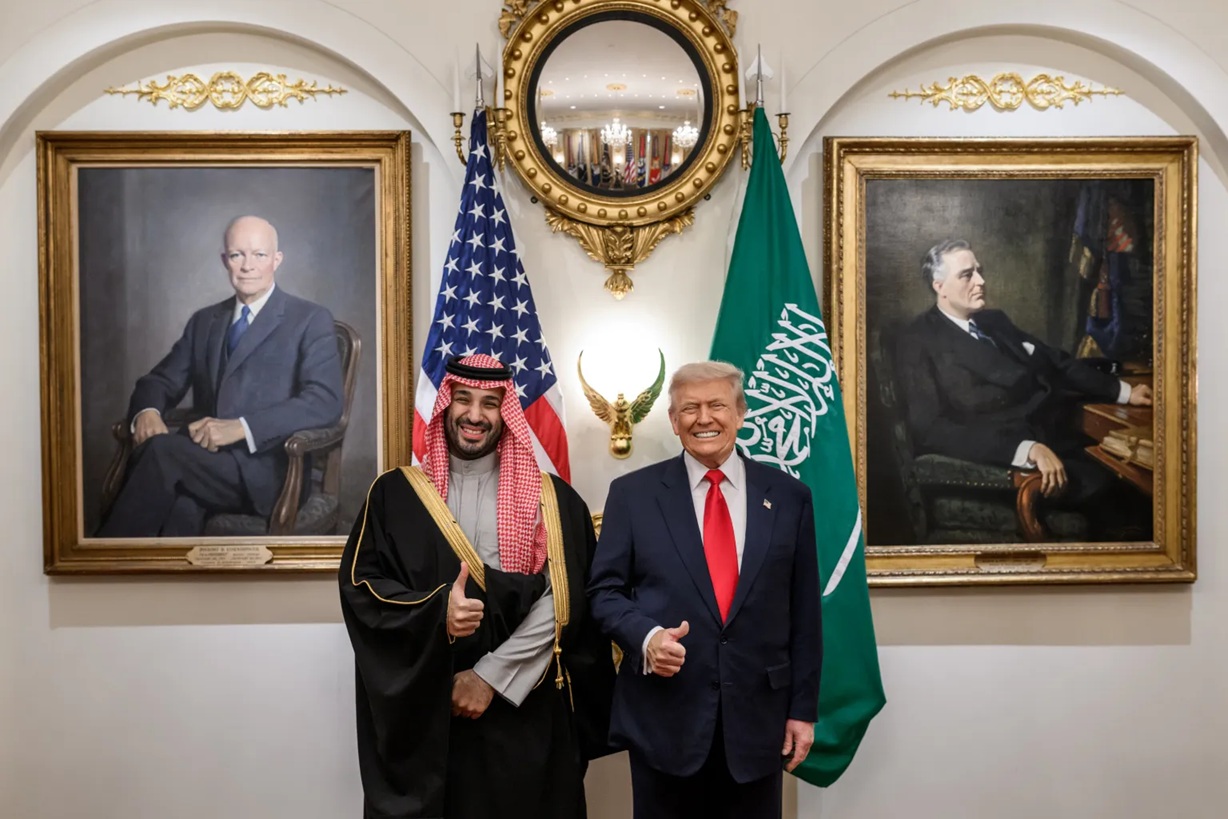
Behind the public statements and diplomatic niceties, a more urgent and consequential conversation has been unfolding between Riyadh and Washington. Saudi Crown Prince Mohammed bin Salman has been privately urging President Trump to press ahead with the military campaign against Iran, not merely to degrade its capabilities, but to bring down its government entirely, according to people briefed by American officials on the discussions. The New York Times first reported the exchanges.
In a series of conversations over recent days, the Crown Prince, widely known as MBS, has framed the current Israel- America offensive as a once-in-a-generation chance to fundamentally redraw the Middle East's power map. The message to Trump, according to those familiar with the talks, has been blunt: do not stop now.
To understand why MBS is pushing so hard, it helps to understand what keeps him up at night. For years, Iran has been the single greatest threat to his vision of a modernised, economically diversified Saudi Arabia, a kingdom open to foreign investment, flush with tourists, and freed from the permanent anxiety of a hostile neighbour with regional ambitions and a nuclear programme inching forward.
The Crown Prince has argued to Trump that Iranian regime represents an existential long-term threat to the Gulf states, one that cannot be managed, only eliminated. According to people familiar with the discussions, he has gone further still, suggesting the America should consider deploying ground forces into Iran to seize its energy infrastructure and accelerate the government’s collapse. Trump, for his part, has recently given more serious thought to a targeted operation to take control of Kharg Island, the nerve centre of Iran's oil export network.
According to The New York Times, the Saudi government flatly denied that the Crown Prince has sought to prolong the conflict. “The Kingdom of Saudi Arabia has always supported a peaceful resolution, even before this began,” the government said in a statement, adding that its “primary concern today is to defend ourselves from the daily attacks on our people and our civilian infrastructure.” Iran, the statement continued, “has chosen dangerous brinkmanship over serious diplomatic solutions.”
The White House offered no elaboration. Press Secretary Karoline Leavitt said the administration “does not comment on the president's private conversations,” according to the Times.
The Hormuz Stranglehold
Whatever MBS says publicly, the economic logic driving his calculations is not hard to follow. Since the conflict erupted, Iranian retaliatory strikes have largely choked off traffic through the Strait of Hormuz, the narrow waterway through which the overwhelming majority of Saudi, Emirati and Kuwaiti oil must pass to reach global markets. Alternative pipeline routes, built precisely for moments like this, have themselves come under attack.
The damage is not merely financial. It strikes at the very heart of the Crown Prince's domestic project. The Saudi Vision 2030 programme, which is his signature bid to transform the kingdom into a global investment and tourism destination. The vision depends entirely on projecting stability and confidence to the outside world. A protracted war, with Iranian drones targeting oil facilities and shipping lanes, makes that pitch nearly impossible.
In this light, analysts say, MBS faces an uncomfortable dilemma. He may never have wanted this war. But with the conflict now underway, a premature American withdrawal could leave Saudi Arabia staring down an Iran that is battered but unbroken and burning with grievance.
“A half-finished offensive would expose Saudi Arabia to frequent Iranian attacks,” is how one analyst familiar with Saudi government thinking summarised the Crown Prince's fear. In that scenario, Iran emerges weakened enough to be dangerous, but not weakened enough to be deterred.
It is worth noting that while Israel and Saudi Arabia share a common adversary, their definitions of victory diverge in important ways. Israel’s Prime Minister Benjamin Netanyahu regards Iran as an existential threat, but Israeli officials would likely accept an Iran consumed by internal chaos, too destabilised to project power outward, as an acceptable outcome. Saudi Arabia, sharing a region and dependent on the same waterways, cannot afford a failed state on its doorstep. Anarchy in Tehran would be a different kind of nightmare for Riyadh.
That distinction matters as Washington weighs how far to take the campaign.
President Trump himself has oscillated publicly, at times suggesting an end to the conflict is within reach, at other times signalling further escalation. On Monday he posted on social media that his administration and Iran had held “productive conversations regarding a complete and total resolution,” a claim Iran promptly disputed.
Senior officials in both Riyadh and Washington privately share one overriding concern that if the conflict drags on indefinitely, Iran could mount increasingly devastating strikes on Gulf oil infrastructure, and the United States could find itself mired in yet another open-ended Middle Eastern war with no clear exit and mounting costs at home.
When Saudi Foreign Minister Prince Faisal was asked last week whether the kingdom preferred an immediate ceasefire or a longer campaign aimed at permanently degrading Iran's military power, he sidestepped the question with a studied precision. “We're going to use every lever we have- political, economic, diplomatic and otherwise- to get these attacks to stop,” he said.
It was a careful answer. But the conversations happening behind closed doors, between a Crown Prince with a kingdom to protect and a president with a decision to make, suggest the stakes are far higher and the choices far harder than any public statement is yet willing to admit.