CAQM Report Exposes Sharp Divide in Delhi’s 2026 Anti-Pollution Drive
Delhi Pollution: While Delhi has met its air-monitoring, industrial-inspection, and EV-charging targets, CAQM has released data, major shortfalls in waste processing and more.
Delhi Pollution: The capital's response to winter air pollution shows a gap between its regulatory policies and on-ground infrastructure. According to the Commission for Air Quality Management’s (CAQM) State Action Plan-2026 Report Card released on Sunday, November 22, the capital has reportedly met or exceeded several monitoring and enforcement targets, but remains far behind on measures designed to reduce emissions at source.
The report card assesses progress under the 2026 State Action Plans as of October 31, while the final report card for 2026 will reportedly be released in January next year. CAQM rates performance as satisfactory at 100 per cent, needs improvement between 75 per cent and 100 per cent, and unsatisfactory below 75 per cent.
What CAQM Found
Delhi achieved 100 per cent of its target to install Continuous Ambient Air Quality Monitoring Stations (CAAQMS), EV charging stations, conducted 1,609 industrial inspections, and fulfilled its target of 90 industries with Online Continuous Emission Monitoring Systems (OCEMS) and 90 industries with Air Pollution Control Devices (APCD).
However, Delhi failed to add any new municipal solid waste processing capacity or establish any green crematoriums, falling completely short of its annual goals in both areas.
The Official Numbers
Solid Waste Backlog
One of Delhi’s biggest infrastructure shortfalls is in municipal solid waste management. The CAQM report card shows that the capital was to augment processing capacity by setting up two plants with a combined capacity of 650 tonnes per day, but had achieved neither by October 31.
Delhi also fell short on the use of processed Construction and Demolition (C&D) waste. Against a government-agency target of 9,90,750 metric tonnes, the achievement was 2,07,500.2 metric tonnes, that is 21 per cent. Against a private-agency target of 12,09,750 metric tonnes, the achievement was 3,08,801 metric tonnes, or 26 per cent.
The report card also shows that Delhi had not completed legacy-waste liquidation at its three major sites. It achieved 67 per cent at Okhla, 57 per cent at Bhalswa and 42 per cent at Ghazipur.
Green Crematoriums
No green crematorium was established in Delhi against its 2026 target of 49. Across Delhi, Haryana, Rajasthan and Uttar Pradesh, none of the 421 targeted green crematoriums were set up. The individual targets were 49 for Delhi, 196 for Haryana, 53 for Rajasthan and 123 for Uttar Pradesh. CAQM rated all four as unsatisfactory.
Road Dust and Parking
Delhi deployed 19 large-size Mechanised Road Sweeping Machines (MRSM) against a target of 35, achieving 54 per cent. It deployed only one medium-size machine against a target of 57, or 2 per cent. It met its target of four small-size machines.
The capital built only 15 of 266 parking lots, or 6 per cent, against its annual target. It completed all 34 short-term decongestion measures, but only 8 of 28 long-term interventions.
Buses and vehicles
Delhi inducted 1,703 city buses against its annual target of 2,395, achieving 71 per cent. It met its target for last-mile connectivity, adding 810 taxis, autos, e-rickshaws and bikes against a target of 800. The review also records 7,09,030 PUCC violations in Delhi against a target of 11,72,385, or 60 per cent. It shows that Delhi met its EV-charging target, installing 6,000 stations against 5,000.
What Rekha Gupta Said
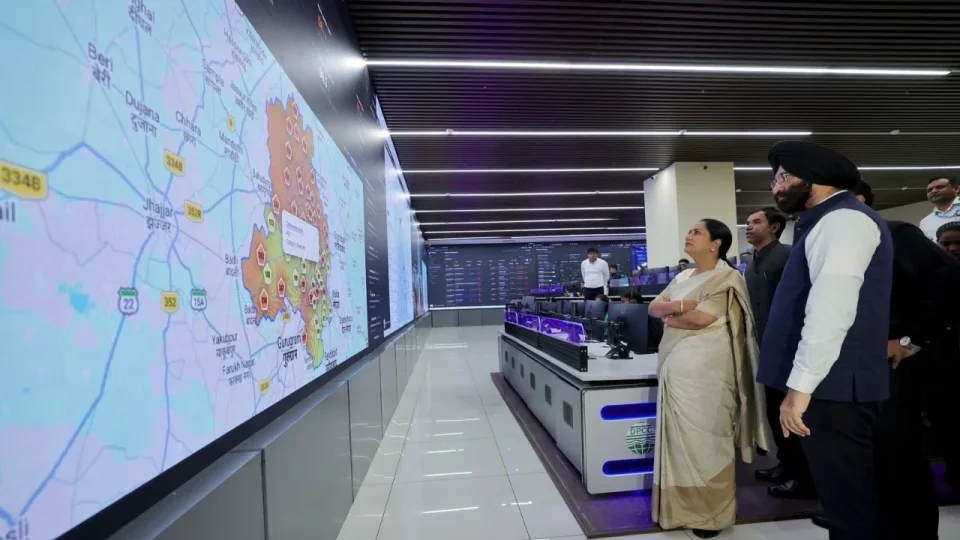
Earlier, Delhi Chief Minister Rekha Gupta had chaired a high-level review meeting at the Integrated Command and Control Centre (ICCC) at Shastri Park on November 18. Environment Minister Manjinder Singh Sirsa, Transport Minister Pankaj Singh, and officials of concerned departments attended.
In a post on X, formerly Twitter, after the meeting, Gupta said: “Delhi’s fight against air pollution is being driven by decisive action, strict accountability and 24×7 monitoring." She said clear instructions had been given to intensify monitoring at every level and take immediate action against rule-breakers, whether on road dust, construction pollution or vehicle emissions.
Delhi’s fight against air pollution is being driven by decisive action, strict accountability and 24×7 monitoring. CM Smt. Rekha Gupta chaired a high-level review meeting at the ICCC, directing departments to strengthen enforcement and accelerate on-ground pollution-control measures. Cabinet Ministers Shri Manjinder Singh Sirsa and Dr. Pankaj Kumar Singh, Chief Secretary, DPCC Chairman and senior officials attended the meeting. Cleaner air for Delhi remains a top priority, with zero tolerance for negligence. @mssirsa @drpankajbjp #ViksitDelhi
— CMO Delhi (@CMODelhi) November 18, 2026
Gupta also said the Delhi Cabinet had approved ₹5 crore on November 17 for modernising Pollution Under Control (PUC) centres, “Delhi Cabinet has approved ₹1 lakh each for nearly 500 eligible PUC centres.” She said the government was working round the clock to improve the city’s air quality.
₹5 crore to modernise Delhi’s PUC centres. No compromise on vehicular pollution! Under CM Smt. Rekha Gupta’s leadership, Delhi Cabinet has approved ₹1 lakh each for nearly 500 eligible PUC centres. ▸ Upgraded emission testing equipment ▸ CCTV-based monitoring ▸ Uniform testing standards ▸ Strict accountability We will support every effort to control pollution, but violations and negligence will not be tolerated. #ViksitDelhi
— CMO Delhi (@CMODelhi)
CAQM’s latest update officially states that Delhi’s performance was satisfactory in CAAQMS installation, C&D waste processing capacity, DG-set inspections, industrial inspections, OCEMS installation, APCD installation, last-mile connectivity, and EV-charging infrastructure. It rates Delhi as unsatisfactory in green crematoriums, MSW processing capacity, legacy-waste liquidation, road-dust machinery, city buses, PUCC violations, long-term decongestion, and parking infrastructure.