The 78-Year Wait for Electricity in the Heart of India: Why It Reached Khairagarh So Late
After 78 years, Khairagarh finally received electricity, marking a historic transformation from Maoist dominance to development and state-led connectivity.
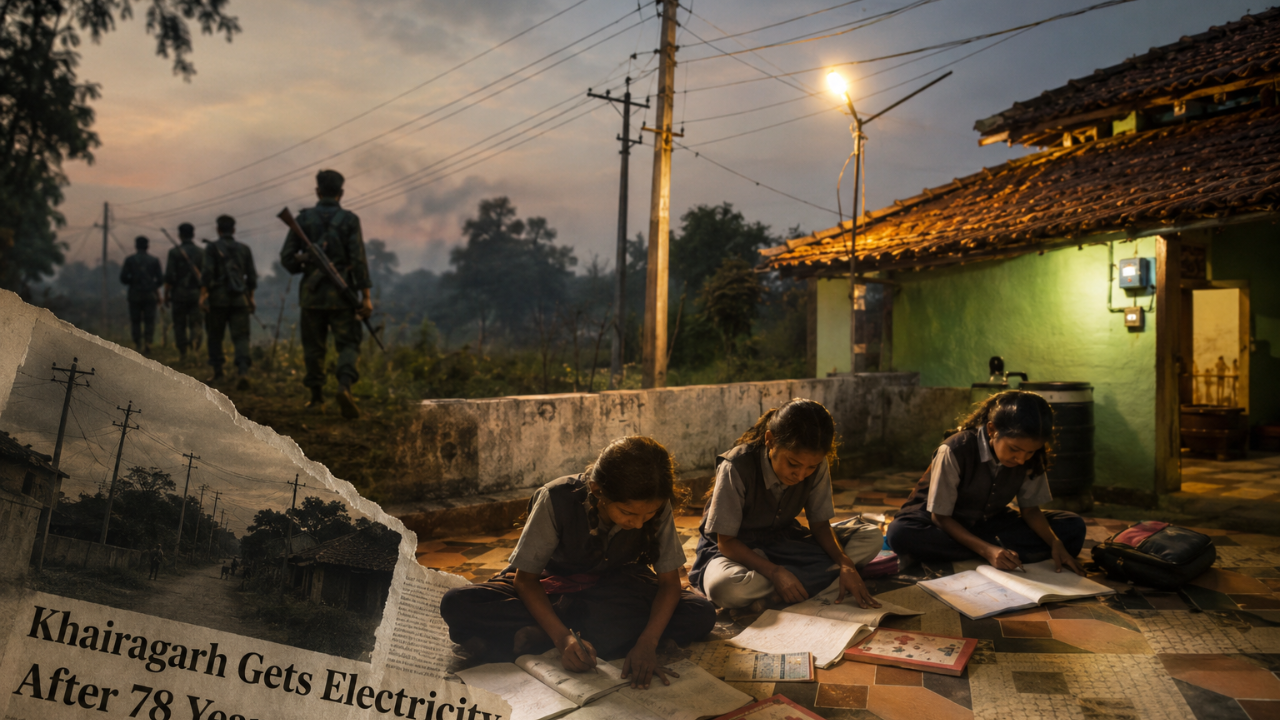
After 78 years, Khairagarh finally received electricity, marking a historic transformation from Maoist dominance to development and state-led connectivity.
By Pranjal Gupta
New Delhi, June 26: Located in the heart of India, a Naxal-affected town in Chhattisgarh, Khairagarh, received electricity for the first time since independence this Friday. For years, its people were cut off from basic facilities under the iron grip of Naxal groups, who barred police officials and government authorities from entering their zone of control. They ran parallel administrations - setting up their own courts, collecting taxes from local bamboo and tendu-patta contractors, thriving in the dense, administrative blind spots of the region and actively restricting state-led development.
In their defense, Naxal groups maintained that the forest land belonged to its people, and that handing it over to the government would only lead to commercialisation, ultimately displacing the very villagers they claimed to protect.
A Princely Past
Before falling into the hands of Naxals, Khairagarh was a princely state ruled by Raja Birendra Bahadur Singh. The Raja and his wife, devastated by the loss of their daughter Indira, chose to honour her memory by donating their ancestral palace to establish a university in her name. That institution - Indira Kala Sangeet Vishwavidyalaya - stands to this day, imparting higher education in Music, Dance, Fine Arts, and Theatre.
Since the university is located in a plains area and a heavily guarded urban municipal center, the Kala center could run smoothly. The Naxal insurgency was almost entirely a rural, forest-based guerrilla movement.
Khairagarh's vulnerability, however, did not stem from local rebellion alone - it was also a matter of geography. The region borders Maharashtra and Madhya Pradesh, forming what security forces call the MMC (Madhya Pradesh-Maharashtra-Chhattisgarh) Tri-Junction zone.
For years, Maoists used this corridor strategically, when pressure mounted from security forces in Bastar or Dantewada in the deep south, Naxal squads melted into the dense forests of Khairagarh and slipped across into Maharashtra or Madhya Pradesh, exploiting jurisdictional gaps between states to evade capture.
The Turning Point
But today, things have changed. In a direct offensive against insurgent networks, the government established police and CAPF (Central Armed Police Forces) camps deep inside former Naxal strongholds like Bakarkatta and Kumhi. All-weather roads were built and mobile networks installed directly inside red zones, systematically dismantling the isolation that the insurgency had long relied upon.
Schoolchildren study under electric lights in Khairagarh, Chhattisgarh, where electricity reached the former Naxal stronghold after 78 years. (Image Source: DD News)
The decisive blow came with the death of notorious Maoist commander Madvi Hidma - the mastermind behind some of Chhattisgarh's deadliest attacks. Hidma was killed in an encounter in the Maredumilli forest in 2025, and his death sent shockwaves through Maoist ranks.
Soon after, Central Committee Member Ramdher Majji, carrying a bounty of Rs 1 crore, surrendered along with 11 top cadres and their weapons at Bakarkatta, Khairagarh. Following this, the government officially declared the MMC zone Naxal-free.
Khairagarh, once a stronghold of insurgency, is now part of the newly formed Khairagarh-Chhuikhadan-Gandai (KCG) district, carved out of Rajnandgaon in 2022 to become Chhattisgarh's 31st district. And this Friday, when the lights came on for the first time, it was not just electricity, it was the arrival of a state that had long been kept out.