Google’s Five Million Dollar IIT Kharagpur Bet: Can India Turn AI Research Into Solutions for its Own Problems?
Google Funds IIT Kharagpur for AI Research: Five million dollars to IIT Kharagpur to support AI research in Indic languages, agriculture, materials science, and education.
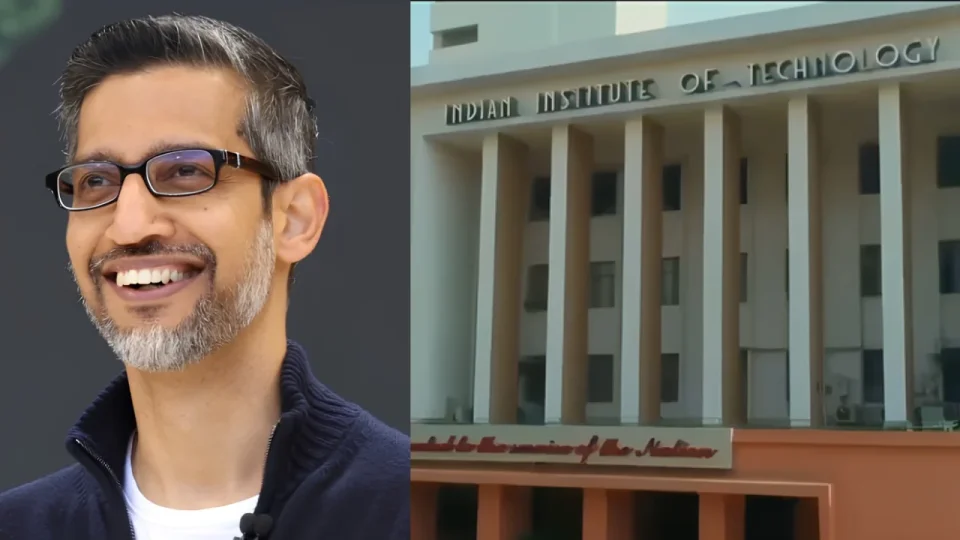
Google’s five-million-dollar partnership with IIT Kharagpur will support AI research in Indic languages, agriculture, materials science, and education. But its real test will be whether the money helps India build usable public tools, or remains confined to laboratories and prototypes. Google's announcement on November 21, posted by Sundar Pichai, CEO of Google and Alphabet, stated that it would provide the Indian Institute of Technology (IIT) Kharagpur with five million dollars, roughly Rs. 46 crore, to develop and accelerate advanced artificial intelligence research and cultivate India’s next generation of science and technology.
The funding is meant to support researchers and students across three areas: Advanced AI Research, Educational Opportunities, and AI Capacity Building. Google says the research component will focus on four priority areas: Indic languages, materials science, agriculture, and educational technology.
What Google is funding
India has several AI activities running and research in process; the core question is whether funding produces datasets, models, tools, and institutions that survive beyond a press release. Google’s announcement does not detail the allocation of funds for specified categories, research domains, or a project-by-project budget of the fund. Neither does it clarify the timeline, expected outcomes, or their public accessibility.
However, it does describe three broad pillars for allocating funds: advancing AI research to tackle real-world challenges across Indic languages, materials science, agriculture, and educational technology; expanding educational opportunities through AI training and curriculum development for students, faculty, and teachers; and building institutional AI capacity by upgrading the university’s frameworks and tooling to strengthen the campus-wide technological ecosystem.
India’s AI Gaps
India’s AI goals face a familiar set of constraints: limited high-end computing capacity, uneven access to high-quality Indian-language data, a shortage of specialised research talent, and difficulty turning laboratory research into widely used products. The government’s IndiaAI Mission has sought to address part of the infrastructure gap. In January 2025, the Ministry of Electronics and Information Technology said the mission’s common compute facility then housed 18,693 GPUs, including 12,896 H100, 1,480 H200 and 7,200 MI 200 300 units, exceeding its initial target of 10,000 GPUs.
But compute is only one input. AI systems also need representative data, domain expertise, and institutions able to test and research in real-world conditions, like language technology. For India, that means building systems that work in Hindi, Tamil, Bengali, Marathi, and hundreds of other languages, apart from English, according to AI4Bharat, a research lab at IIT Madras.
Indic Languages
AI4Bharat has been working on open-source datasets, tools, models, and applications for Indian languages. Its work includes IndicTrans and IndicTrans2, neural machine-translation models for English and 22 Indian languages, as well as datasets such as Samanantar and BPCC. The lab’s IndicCorp v2 dataset covers 23 Indian languages and is designed for pre-training Indic language models. That is a meaningful foundation, but it also illustrates the scale of the challenge: building useful AI for India requires sustained work across languages, dialects, domains, and use cases. The Wadhwani School of Data Science and AI said to have been “collecting voice data from 500 districts in India, where participants come from different demographics,” He elaborated that it “would be used to train the machine models” to incorporate regional languages into AI research.
Google’s support for Indic-language research at IIT Kharagpur could add to this ecosystem. Its value will depend on whether the institute builds on existing open resources, avoids duplicating work, and makes its outputs usable by Indian developers, researchers, and public institutions.
Agriculture and Education
AI is often presented as a solution for Indian agriculture, but the practical barriers are considerable. Farmers need tools that work with local crops, languages, weather conditions, soil types, and limited connectivity. A model that performs well in a laboratory may be of little use if it cannot run on a low-cost phone or provide reliable advice during a crop-disease outbreak.
Wadhwani AI, which works on AI applications in agriculture, healthcare and education, has focused on translating research into field-ready tools. Its work illustrates the gap Google’s funding will need to bridge: an AI model is only useful if it can be deployed, maintained and trusted by the people expected to use it.
Education presents a similar challenge. AI could support personalised learning, teacher training and regional-language instruction, but it cannot compensate for unequal access to devices, electricity, internet connectivity and trained teachers. Google’s funding for educational technology will therefore be judged not by the sophistication of its models, but by whether it improves access and learning outcomes in Indian classrooms.
Materials Science
Materials science is likely to be the least publicly discussed of the four research areas, but it may have the clearest industrial relevance. AI can help researchers identify and test new materials for semiconductors, energy storage, batteries and advanced manufacturing.
For India, the opportunity lies in using AI to accelerate materials discovery rather than relying entirely on imported technology. But the field requires expensive laboratory infrastructure, specialised talent and close collaboration between universities, industry and government. A five-million-dollar grant might be able to support a research programme; it cannot by itself build a domestic materials-science ecosystem.
The Independence Question
The partnership raises a broader question: can collaborations with global technology companies strengthen India’s AI capabilities, or do they risk deepening dependence on foreign models, platforms and computing infrastructure? Google’s funding could help IIT Kharagpur develop local expertise, datasets and applied research capacity. But the value of that support depends on the terms of the partnership, including who owns the intellectual property, whether datasets and models remain publicly accessible, and whether Indian researchers can build independently on the results.
The IndiaAI Mission’s compute facility suggests that India is trying to build more of its own infrastructure. Yet the country’s AI ecosystem still relies heavily on foreign models, cloud platforms and advanced hardware. The test for Google’s partnership is whether it adds to India’s own research base or simply extends the reach of a foreign company’s technology stack.
Measurability of Success
For IIT Kharagpur, success should not be measured only by publications, patents or student enrolment. It should be measured by whether the partnership produces tools that work in Indian conditions: language models that understand regional speech, agricultural tools that farmers can use, educational software that reaches government schools and materials research that supports domestic manufacturing.
That will require clear milestones, public reporting and independent evaluation. Google’s announcement says the funding will support research, training and capacity building, but it does not yet specify how success will be measured.
India’s need is not based solely on AI Research or mere announcements. It needs research that becomes usable infrastructure, open datasets, models that work in Indian languages, tools that reach farmers and students, and institutions that can maintain them after the initial funding ends.